Running a business is not only about selling products or services. As soon as a company hires employees, it must handle payroll, taxes, benefits, HR policies, compliance, workers’ compensation, employee documentation, risk management, hiring support, onboarding, and workplace rules.

For many small and growing businesses, these responsibilities become too much to manage internally.

A business owner may be good at sales, operations, marketing, or customer service, but payroll compliance and HR administration can still become stressful. Hiring a full HR team may be too expensive. Managing everything manually can create mistakes. That is why many companies work with a PEO.

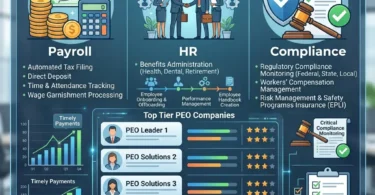
A Professional Employer Organization, or PEO, helps businesses outsource important HR responsibilities. The best PEO companies can support payroll processing, payroll tax administration, employee benefits, HR compliance, workers’ compensation, risk management, onboarding, employee self-service, and access to HR experts.

For small businesses, startups, local companies, professional services, agencies, remote teams, and growing employers, a PEO can reduce HR workload and help the business offer better employee benefits.

In this guide, we will compare the best PEO companies for payroll, HR, and compliance, explain how PEO services work, and help you choose the right PEO for your business.


What Is a PEO?

A PEO, or Professional Employer Organization, is a company that provides outsourced HR services to businesses. A PEO usually helps with payroll, employee benefits, HR administration, workers’ compensation, risk management, compliance support, and employee records.

Many PEOs use a co-employment model. That means the business still manages daily work, employees, company culture, job duties, and business operations, while the PEO shares certain employer-related responsibilities such as payroll administration, benefits administration, tax filings, and HR compliance support.

A PEO can help with:

  • Payroll processing
  • Payroll tax administration
  • Employee benefits
  • Health insurance access
  • Retirement plans
  • Workers’ compensation
  • HR compliance support
  • Employee handbook support
  • HR policy guidance
  • Hiring and onboarding
  • Employee records
  • Risk management
  • Safety support
  • HR expert access
  • Time tracking integrations
  • Termination guidance
  • Employee self-service

ADP describes its TotalSource PEO as an all-in-one HR solution that takes on complicated and time-consuming HR tasks, with support for HR, payroll, benefits, workers’ compensation, risk, safety, and more.


Why Businesses Use PEO Companies

Businesses use PEO companies because HR, payroll, and compliance become harder as the team grows.

A PEO can help solve several common business problems.

1. Payroll Becomes Easier

Payroll includes wages, salaries, deductions, taxes, direct deposit, pay records, year-end forms, and employee questions. PEOs help manage payroll administration and reduce manual work.

2. Better Employee Benefits

Small businesses may struggle to offer competitive benefits. A PEO can help businesses access benefits options and administer employee benefits more efficiently.

Justworks says its PEO helps businesses manage benefits, payroll, HR, and compliance in one place through a modern certified PEO platform with 24/7 support.

3. HR Compliance Support

Employment rules can be complex. PEOs can provide HR guidance, templates, employee handbooks, compliance alerts, and documentation support.

4. Workers’ Compensation and Risk Management

PEOs often help with workers’ compensation, safety programs, claims administration, and risk management.

5. HR Expert Access

Small businesses may not have in-house HR professionals. A PEO can provide access to HR specialists.

ADP TotalSource includes a dedicated HR business partner as a main point of contact, plus specialists for payroll, tax, workers’ compensation, risk, safety, and benefits administration.

6. Business Owners Save Time

Instead of spending hours on payroll, benefits questions, forms, and compliance tasks, business owners can focus on growth.

7. Employee Experience Improves

Employees can access benefits, pay information, HR support, and self-service tools more easily.


Best PEO Companies for Payroll, HR and Compliance

Below are some of the best PEO companies for small businesses, growing teams, startups, remote teams, professional service firms, and companies that want outsourced HR support.


1. ADP TotalSource

Best for: Growing businesses that want a large, established PEO provider
Good for: Payroll, HR, benefits, risk management, compliance, workers’ compensation
Main strength: Deep payroll and HR expertise with strong service infrastructure

ADP TotalSource is one of the most well-known PEO companies. ADP is already a major name in payroll and HR, and TotalSource is its PEO solution for businesses that want more complete outsourced HR support.

ADP TotalSource provides payroll, HR, benefits administration, risk management, workers’ compensation, compliance support, employee self-service, and access to HR experts.

Key Features

  • Full-service payroll
  • Payroll tax administration
  • Employee benefits access
  • Benefits administration
  • HR support
  • Dedicated HR business partner
  • Workers’ compensation support
  • Risk and safety guidance
  • Compliance resources
  • Talent management support
  • Employee self-service
  • ADP technology platform
  • HR specialist access
  • Reporting and analytics

Why ADP TotalSource Is Good for Payroll, HR and Compliance

ADP TotalSource is strong because ADP has deep experience in payroll, tax, HR, and compliance services. Businesses that want a large provider with a broad support network may feel more comfortable with ADP.

ADP’s official TotalSource page says the solution provides support and cloud technology for HR, talent, risk, and payroll, plus access to employee benefits.

Best Fit

ADP TotalSource is best for growing small and mid-sized businesses that want a trusted, established PEO with broad payroll, HR, compliance, and benefits support.

Possible Downsides

ADP pricing is usually quote-based. Small businesses should request a full cost breakdown and compare it with Justworks, Paychex, TriNet, Insperity, and Rippling.


2. Justworks

Best for: Startups and small businesses that want simple PEO pricing and modern software
Good for: Payroll, benefits, compliance, HR tools, employee self-service
Main strength: Easy-to-use PEO platform for small businesses

Justworks is one of the most popular PEO companies for startups and small businesses. It focuses on making payroll, benefits, HR, and compliance easier through a modern platform and support team.

Justworks says thousands of small businesses use its platform to handle payroll, compliance, benefits, HR, and more. It also says it processed over $31 billion in payroll in 2025.

Key Features

  • Payroll processing
  • Payroll tax support
  • Benefits access
  • HR compliance support
  • Employee self-service
  • Time tracking options
  • Contractor payments
  • 24/7 support
  • HR tools
  • Onboarding
  • PTO management
  • Reporting
  • Certified PEO platform
  • Domestic and global team support

Why Justworks Is Good for Small Businesses

Justworks is strong because it is designed to be easier to understand than many traditional PEO providers. Small businesses often want clear software, simple workflows, accessible support, and fewer confusing HR processes.

Justworks PEO helps businesses handle benefits, payroll, HR, and compliance in one place, and its official page highlights a modern certified PEO platform with 24/7 support.

Best Fit

Justworks is best for startups, small businesses, agencies, remote teams, and companies that want a modern PEO with user-friendly software.

Possible Downsides

Justworks may not be the best fit for companies that need highly customized enterprise HR services or industry-specific HR consulting.


3. TriNet PEO

Best for: Businesses that want industry-focused HR, payroll, benefits, and compliance support
Good for: Professional services, tech, life sciences, finance, nonprofits, SMBs
Main strength: Industry-specific HR outsourcing and benefits support

TriNet is a major HR outsourcing and PEO provider for small and mid-sized businesses. It provides HR solutions including payroll, benefits, risk management, compliance, and HR support.

TriNet says it provides businesses with HR solutions including payroll, benefits, risk management, and compliance in one place. It also says it works with small to medium-size businesses from five to more than 1,000 employees.

Key Features

  • Payroll processing
  • Benefits administration
  • HR compliance support
  • Risk management
  • Industry-specific HR support
  • Employee self-service
  • HR experts
  • Workers’ compensation support
  • Time and attendance options
  • Reporting
  • Employee onboarding
  • HR platform
  • Benefits compliance support

Why TriNet Is Good for HR and Compliance

TriNet is strong because it offers industry-focused HR solutions. Different industries have different HR and compliance needs. A software company, law firm, nonprofit, consulting agency, and life sciences company may all need different support.

TriNet also provides benefits compliance support. Its benefits compliance page says TriNet-sponsored benefits can include assistance with multi-state reporting requirements, retirement plan filings, COBRA-related communications, and ACA reporting.

Best Fit

TriNet PEO is best for small and mid-sized businesses that want industry-specific HR support, benefits administration, payroll, compliance, and risk management.

Possible Downsides

TriNet pricing is personalized and depends on company factors. Businesses should compare quotes and support levels carefully.


4. Paychex PEO

Best for: Small and mid-sized businesses that want flexible HR, payroll, and compliance services
Good for: Payroll, benefits, HR support, compliance, workers’ compensation
Main strength: Payroll and HR services with customizable PEO support

Paychex is a major payroll and HR provider. Its PEO services can help businesses manage payroll, HR, benefits, compliance, risk, and employee administration.

Paychex is especially relevant for small and mid-sized businesses that want payroll plus HR outsourcing support.

Key Features

  • Payroll processing
  • Payroll tax services
  • HR administration
  • Benefits administration
  • Workers’ compensation
  • Risk management
  • HR compliance support
  • Employee self-service
  • Time and attendance
  • Recruiting and onboarding tools
  • Reporting
  • HR professional support
  • Business insurance options

Why Paychex PEO Is Good for Small Businesses

Paychex is strong because it has long experience serving small and mid-sized businesses. It can support companies that need payroll, benefits, HR tools, compliance support, and access to HR professionals.

Paychex small business solutions include payroll, employee benefits administration, time and attendance tracking, HR compliance support, new hire reporting, tax filing, and access to HR professionals.

Best Fit

Paychex PEO is best for small and mid-sized businesses that want flexible payroll, HR, benefits, and compliance support.

Possible Downsides

Paychex may not be as simple or transparent as some modern PEO platforms. Ask for a clear pricing breakdown before signing.


5. Insperity

Best for: Businesses that want full-service HR outsourcing and employee development support
Good for: HR administration, payroll, benefits, training, performance, risk management
Main strength: Full-service HR support and business performance focus

Insperity is a well-known PEO and HR outsourcing provider. It is often used by small and mid-sized businesses that want a more service-heavy HR partner.

Insperity commonly focuses on HR administration, payroll, benefits, compliance support, employee training, performance management, and business support services.

Key Features

  • Payroll administration
  • Benefits administration
  • HR compliance support
  • Employee training
  • Performance management support
  • Recruiting support
  • Risk management
  • Workers’ compensation
  • HR consulting
  • Employee self-service
  • Reporting
  • Business performance support

Why Insperity Is Good for HR Outsourcing

Insperity is strong for businesses that want more than basic payroll and benefits. It can be a good fit for companies that want HR guidance, employee training resources, performance support, and full-service HR outsourcing.

Recent PEO market comparisons regularly list Insperity among major PEO alternatives alongside ADP TotalSource, Justworks, Deel, Paychex, Rippling, and TriNet.

Best Fit

Insperity is best for small and mid-sized businesses that want full-service HR outsourcing with a consultative approach.

Possible Downsides

Insperity may be more service-heavy and potentially more expensive than simpler PEO options.


6. Rippling PEO

Best for: Tech-forward growing companies that want HR, payroll, IT, and PEO services together
Good for: Startups, remote teams, SaaS companies, scaling businesses
Main strength: Modern HR technology with automation across employee lifecycle

Rippling is a workforce platform that combines HR, payroll, benefits, IT, app access, devices, finance, and automation. Rippling also offers PEO services for companies that want HR outsourcing support.

Key Features

  • PEO services
  • Payroll
  • Benefits administration
  • HRIS
  • Time and attendance
  • Compliance workflows
  • Employee onboarding
  • App provisioning
  • Device management
  • Identity and access management
  • Workflow automation
  • Reporting
  • Global workforce options
  • Employee self-service

Why Rippling PEO Is Good for Growing Companies

Rippling is strong because it connects HR and payroll with IT operations. When an employee joins, changes roles, or leaves, the company may need to update payroll, benefits, app access, devices, permissions, and HR records. Rippling helps automate these employee lifecycle workflows.

A recent PEO service review listed Rippling as best for scalability, highlighting its tech-forward solutions and automation for companies seeking growth and flexibility.

Best Fit

Rippling PEO is best for startups, technology companies, remote teams, and fast-growing businesses that want modern HR software plus PEO services.

Possible Downsides

Rippling may be more advanced than what a very small local business needs.


7. Deel PEO

Best for: Remote and globally minded companies
Good for: Remote teams, international hiring, contractor management, global payroll
Main strength: Global workforce platform with PEO-style and international employment support

Deel is best known for global payroll, contractor management, employer of record services, and international workforce support. It also appears in modern PEO comparisons because many companies now need HR, payroll, and compliance support across borders.

A 2026 PEO buyer guide listed Deel among top PEO service providers, especially for companies with global or distributed workforce needs.

Key Features

  • Global payroll
  • Contractor management
  • Employer of record services
  • HR tools
  • Compliance documentation
  • Benefits support
  • Localized contracts
  • International onboarding
  • Multi-country workforce management
  • Employee self-service
  • Reporting
  • Remote team support

Why Deel Is Good for Global Teams

Deel is useful because hiring across countries creates compliance complexity. A local U.S.-focused PEO may not be enough if your team includes international employees or contractors.

Deel can help remote companies manage international hiring, payments, contracts, compliance, and workforce administration.

Best Fit

Deel is best for remote-first companies, startups, and businesses hiring employees or contractors internationally.

Possible Downsides

For local-only small businesses, Justworks, ADP TotalSource, Paychex, TriNet, or Insperity may be more suitable.


8. XcelHR

Best for: Small businesses that want flexible PEO and HR outsourcing support
Good for: Small teams, payroll, benefits, workers’ comp, HR administration
Main strength: Flexible HR outsourcing for small businesses

XcelHR is a PEO and HR outsourcing provider focused on small and mid-sized businesses. It can support payroll, benefits, HR administration, workers’ compensation, compliance, and risk management.

A 2025 PEO service guide listed XcelHR as best suited for small businesses, noting no minimum employee count and customizable HR solutions.

Key Features

  • Payroll administration
  • Benefits administration
  • HR support
  • Workers’ compensation
  • Risk management
  • Compliance support
  • Employee self-service
  • HR consulting
  • Time and attendance options
  • Recruiting support
  • Employee records
  • Reporting

Why XcelHR Is Good for Small Businesses

XcelHR is useful for small businesses that may not meet minimum employee requirements at some larger PEOs. It can be a practical option for companies that want HR outsourcing but still need flexibility.

Best Fit

XcelHR is best for small businesses looking for flexible PEO support.

Possible Downsides

Businesses should compare platform experience, service levels, benefits options, and pricing against larger providers.


9. Engage PEO

Best for: Businesses that want strong HR consulting and compliance support
Good for: Mid-sized businesses, HR support, payroll, benefits, compliance
Main strength: HR service model with compliance and advisory support

Engage PEO is a professional employer organization that provides HR outsourcing, payroll, benefits, workers’ compensation, risk management, and compliance support.

A 2025 PEO service review listed Engage PEO as tailored for mid-sized businesses, with full-service HR, legal compliance, and benefits management.

Key Features

  • Payroll administration
  • HR consulting
  • Compliance support
  • Benefits administration
  • Workers’ compensation
  • Risk management
  • Employee relations support
  • HR policies
  • Recruiting support
  • Training support
  • Employee self-service
  • Reporting

Why Engage PEO Is Good for HR and Compliance

Engage PEO can be useful for businesses that want stronger human HR guidance and compliance support rather than only software.

This can matter for companies dealing with employee relations, workplace policy, compliance questions, and HR processes.

Best Fit

Engage PEO is best for small and mid-sized businesses that want HR advisory support, payroll, benefits, and compliance help.

Possible Downsides

Businesses that prefer modern self-service software with clear online pricing may prefer Justworks or Rippling.


10. CoAdvantage

Best for: Small and mid-sized businesses that want payroll, HR, benefits, and risk support
Good for: HR outsourcing, payroll, benefits, workers’ compensation, compliance
Main strength: PEO services for SMBs with operational HR support

CoAdvantage is a PEO provider that helps small and mid-sized businesses with HR administration, payroll, benefits, workers’ compensation, and compliance support.

Key Features

  • Payroll administration
  • HR support
  • Benefits administration
  • Workers’ compensation
  • Risk management
  • Compliance support
  • Employee self-service
  • Time and attendance options
  • Recruiting support
  • Performance support
  • Employee records
  • Reporting

Why CoAdvantage Is Good for SMBs

CoAdvantage can be useful for companies that want a PEO partner to reduce HR workload and support payroll, benefits, and compliance.

It is especially relevant for businesses that need a service-oriented HR outsourcing provider rather than only payroll software.

Best Fit

CoAdvantage is best for small and mid-sized businesses that want traditional PEO support for HR, payroll, benefits, and risk management.

Possible Downsides

Companies should compare technology, benefits options, support quality, and total fees with other PEOs before choosing.


Quick Comparison Table

PEO CompanyBest ForMain StrengthBest Business Type
ADP TotalSourceGrowing businessesLarge payroll, HR, benefits, compliance ecosystemSMBs and scaling companies
JustworksStartups and SMBsModern platform, payroll, benefits, complianceSmall businesses and startups
TriNet PEOIndustry-specific supportHR, benefits, risk, compliance by industrySMBs and professional firms
Paychex PEOFlexible HR supportPayroll, HR, benefits, compliance servicesSmall and mid-sized businesses
InsperityFull-service HR outsourcingHR consulting, training, performance supportSMBs needing service-heavy HR
Rippling PEOTech-forward companiesHR, payroll, IT, automationStartups and remote teams
Deel PEOGlobal teamsInternational payroll and complianceRemote/global companies
XcelHRSmaller businessesFlexible PEO supportSmall businesses
Engage PEOHR advisory supportHR consulting and complianceMid-sized businesses
CoAdvantageTraditional PEO supportPayroll, HR, benefits, risk managementSMBs

Important Features to Look for in a PEO

Choosing the best PEO company is not only about price. The right PEO should fit your business size, industry, risk level, growth plans, and employee needs.

1. Payroll Processing

The PEO should handle payroll accurately, including wages, taxes, deductions, direct deposit, and payroll records.

2. Payroll Tax Administration

Payroll tax compliance is a major reason businesses use PEOs. The provider should support required filings and payments.

3. Employee Benefits

A strong PEO should help businesses offer competitive employee benefits such as health insurance, dental, vision, retirement plans, life insurance, disability coverage, and wellness programs.

4. HR Compliance Support

The PEO should provide guidance on employment policies, employee handbooks, documentation, wage rules, leave, and workplace compliance.

5. Workers’ Compensation

Many PEOs help with workers’ compensation coverage, claims, and safety guidance.

6. Risk Management

Risk support may include workplace safety, claims management, compliance advice, and employee relations guidance.

7. HR Expert Access

Small businesses often need access to HR specialists for hiring, discipline, termination, leave, documentation, and policy questions.

8. Employee Self-Service

Employees should be able to access pay stubs, benefits information, documents, and HR support online.

9. Technology Platform

A good PEO should have easy software for payroll, benefits, onboarding, employee data, documents, and reporting.

10. Customer Support

Support quality matters. Ask whether support is available by phone, email, chat, or dedicated HR partner.


PEO vs Payroll Software

A PEO is different from payroll software.

Payroll Software

Payroll software helps businesses:

  • Run payroll
  • Calculate wages
  • Process direct deposit
  • Manage payroll taxes
  • Generate pay stubs
  • Pay contractors
  • Create reports

PEO

A PEO can include payroll, but it also supports:

  • HR administration
  • Employee benefits
  • Compliance
  • Workers’ compensation
  • Risk management
  • HR guidance
  • Employee handbooks
  • Employee relations
  • Safety support

If your business only needs basic payroll, software like Gusto, QuickBooks Payroll, OnPay, or Patriot may be enough. If you need payroll plus benefits, HR compliance, workers’ comp, and HR support, a PEO may be better.


PEO vs ASO

PEO and ASO are often compared.

PEO

A PEO usually uses a co-employment model and may help administer payroll, benefits, workers’ comp, HR compliance, and risk management.

ASO

An ASO, or Administrative Services Organization, provides HR administrative support but usually does not use the same co-employment structure.

TriNet’s FAQ notes that every business is different and offers an HR Solution Assessment to help determine whether a PEO, ASO, or similar solution could be the best fit.

Which One Is Better?

Choose a PEO if you want deeper outsourced HR support, benefits access, and shared employer-related administration.

Choose an ASO if you want administrative help but do not want a co-employment arrangement.


Best PEO by Business Type

Best PEO for Startups

Justworks, Rippling PEO, and TriNet are strong options for startups.

Best PEO for Small Businesses

Justworks, ADP TotalSource, Paychex PEO, XcelHR, and CoAdvantage are strong options.

Best PEO for Growing Companies

ADP TotalSource, TriNet, Paychex, Insperity, and Rippling are strong choices.

Best PEO for Tech Companies

Rippling, Justworks, TriNet, and Deel are strong options depending on company size and global hiring needs.

Best PEO for Global Teams

Deel and Rippling are more relevant for global and remote workforce needs.

Best PEO for HR Support

Insperity, Engage PEO, Paychex, ADP TotalSource, and TriNet are strong if HR guidance matters most.

Best PEO for Benefits

TriNet, ADP TotalSource, Justworks, Paychex, and Insperity are strong options to compare.


How Much Does a PEO Cost?

PEO pricing depends on many factors:

  • Number of employees
  • Payroll size
  • Business location
  • Industry risk
  • Workers’ compensation needs
  • Benefits plans
  • HR support level
  • Payroll frequency
  • Technology platform
  • Compliance needs
  • Contract terms
  • Service model

Some PEOs charge a per-employee monthly fee. Others charge a percentage of payroll. Some may include additional fees for benefits, workers’ compensation, implementation, or special services.

When comparing PEO pricing, ask:

  • Is pricing per employee or percentage of payroll?
  • What is included in the base fee?
  • Are payroll taxes included?
  • Are workers’ compensation costs separate?
  • Are benefits costs separate?
  • Is HR support included?
  • Is there a setup fee?
  • Is there a minimum employee count?
  • What contract length is required?
  • Are there cancellation fees?
  • What software is included?
  • What support channels are included?

Do not choose a PEO only because it is the cheapest. Poor HR support, weak benefits, unclear pricing, or bad service can cost more in the long run.


Benefits of Using a PEO

Less HR Admin Work

The PEO helps manage payroll, benefits, compliance, and HR tasks.

Better Employee Benefits

Small businesses may gain access to more competitive benefits options.

HR Expert Support

Business owners can ask HR professionals about policies, documents, employee issues, and compliance questions.

Compliance Help

PEOs help businesses reduce compliance risk related to payroll, employment rules, benefits, and HR documentation.

Workers’ Compensation Support

PEOs may help with workers’ compensation coverage, claims, and safety programs.

Better Employee Experience

Employees get easier access to pay information, benefits, HR support, and self-service tools.

More Time for Growth

Owners and managers can spend less time on HR administration and more time on business priorities.


Possible Downsides of Using a PEO

A PEO is not perfect for every business.

Less Control

Some businesses may feel they have less control over HR processes, benefits options, or provider rules.

Cost

PEO services can be more expensive than basic payroll software.

Contract Complexity

PEO agreements can include many details about fees, responsibilities, insurance, benefits, and termination terms.

Provider Fit Matters

A PEO that works well for one company may not fit another. Industry, location, workforce type, and support needs matter.

Switching Can Be Work

Changing PEOs can involve payroll transitions, benefits changes, employee communication, and data migration.


Common Mistakes When Choosing a PEO

Mistake 1: Choosing Only Based on Price

Low cost does not always mean good value. Support, benefits quality, technology, and compliance expertise matter.

Mistake 2: Not Understanding the Contract

Review fees, responsibilities, cancellation rules, benefits terms, and service scope.

Mistake 3: Ignoring Benefits Quality

Employee benefits are one of the biggest reasons to use a PEO. Compare plan options carefully.

Mistake 4: Not Checking Support Model

Ask whether you get a dedicated HR partner, general support team, 24/7 support, or specialist access.

Mistake 5: Not Asking About Workers’ Compensation

Workers’ comp costs and claims support can affect total value.

Mistake 6: Ignoring Technology

Employees and managers need easy payroll, benefits, onboarding, and document access.

Mistake 7: Not Comparing PEO vs Payroll Software

Some businesses only need payroll software, not full PEO services.

Mistake 8: Not Planning Employee Communication

Moving to a PEO affects employees. Explain benefits, payroll changes, portals, and support clearly.


How to Choose the Best PEO Company

Use this checklist before choosing a PEO.

Step 1: Define Your Main Problem

Do you need payroll help, better benefits, HR compliance, workers’ comp, HR experts, or all of these?

Step 2: Compare Service Scope

Make sure the PEO includes the services you actually need.

Step 3: Review Benefits Options

Compare health, dental, vision, retirement, life insurance, disability, and wellness options.

Step 4: Ask About HR Support

Find out whether support is general or dedicated.

Step 5: Check Payroll and Tax Processes

Payroll accuracy is critical.

Step 6: Review Compliance Support

Ask how the PEO helps with handbooks, policies, leave, wage rules, employee documents, and HR questions.

Step 7: Compare Pricing Clearly

Ask for all fees in writing.

Step 8: Review the Technology Platform

Request a demo of payroll, benefits, onboarding, employee self-service, and reporting.

Step 9: Check Industry Experience

A PEO with experience in your industry may understand your needs better.

Step 10: Read the Agreement Carefully

Review contract terms before signing.


Final Verdict: What Is the Best PEO Company?

The best PEO company depends on your business size, industry, employee count, location, HR needs, and growth plans.

For most businesses:

  • Best overall established PEO: ADP TotalSource
  • Best modern PEO for startups: Justworks
  • Best industry-focused PEO: TriNet PEO
  • Best flexible payroll and HR PEO: Paychex PEO
  • Best full-service HR outsourcing: Insperity
  • Best tech-forward PEO: Rippling PEO
  • Best for global teams: Deel
  • Best flexible small-business PEO: XcelHR
  • Best HR advisory PEO: Engage PEO
  • Best traditional SMB PEO support: CoAdvantage

If your business wants a large and trusted provider, compare ADP TotalSource, Paychex, and TriNet. If you want a modern platform for startups and small teams, compare Justworks and Rippling. If you need global workforce support, compare Deel and Rippling. If you want service-heavy HR guidance, compare Insperity, Engage PEO, and CoAdvantage.

The most important point is simple: a good PEO should help your business run payroll accurately, offer better benefits, reduce HR workload, manage compliance risk, and give employees a better HR experience.


FAQs About PEO Companies

What is the best PEO company?

The best PEO company depends on your needs. ADP TotalSource is strong for established payroll and HR support, Justworks is strong for startups and small businesses, TriNet is good for industry-focused HR support, Paychex is strong for flexible payroll and HR services, and Rippling is strong for tech-forward growing companies.

What does a PEO do?

A PEO helps businesses manage payroll, employee benefits, HR administration, compliance support, workers’ compensation, risk management, employee records, onboarding, and HR guidance.

Is a PEO good for small businesses?

Yes. A PEO can help small businesses reduce HR workload, access better benefits, manage payroll, get HR guidance, and support compliance.

What is co-employment?

Co-employment is a model where the business remains responsible for daily work and operations, while the PEO shares certain employer-related responsibilities such as payroll, benefits administration, HR support, and compliance-related administration.

Is Justworks a good PEO?

Yes. Justworks is a strong PEO for small businesses and startups. It helps businesses manage benefits, payroll, HR, and compliance in one modern certified PEO platform with 24/7 support.

Is ADP TotalSource a good PEO?

Yes. ADP TotalSource is a strong PEO for growing businesses that want payroll, HR, benefits, risk, compliance, and expert support from a large established provider.

Is TriNet a good PEO?

Yes. TriNet offers HR solutions including payroll, benefits, risk management, and compliance, and works with small to medium-size businesses from five to more than 1,000 employees.

What is the difference between PEO and payroll software?

Payroll software mainly helps process payroll. A PEO usually includes payroll plus HR support, benefits administration, compliance support, workers’ compensation, and risk management.

How much does a PEO cost?

PEO pricing depends on employee count, payroll size, benefits, industry risk, workers’ compensation, HR support level, and provider model. Some charge per employee per month, while others charge a percentage of payroll.

When should a business use a PEO?

A business should consider a PEO when payroll, benefits, HR compliance, workers’ compensation, and employee administration become too time-consuming or risky to manage alone.