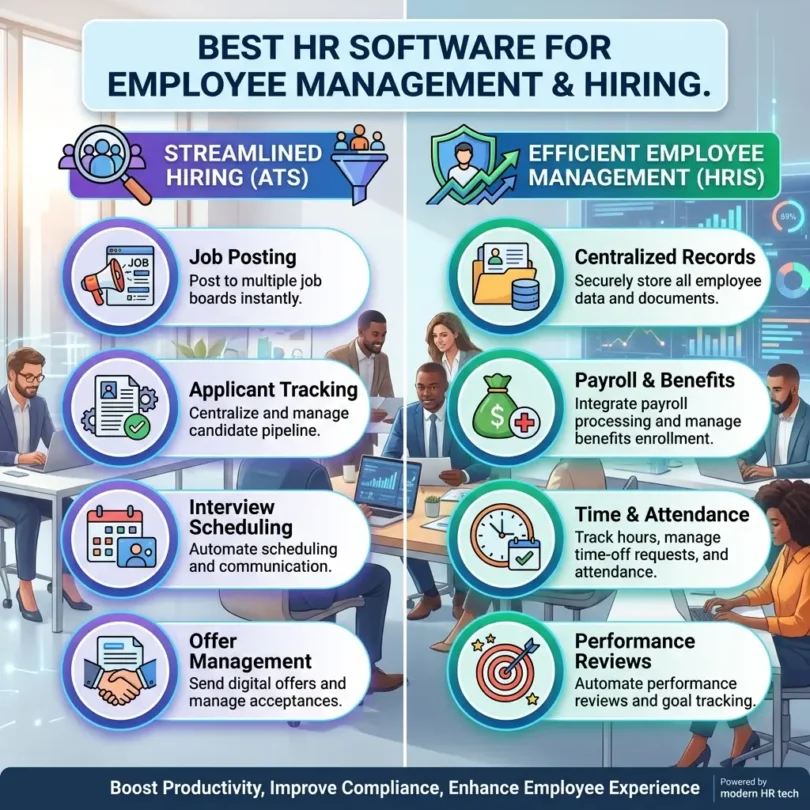

Managing employees is one of the most important parts of running a business. A company may start with only a few people, but as the team grows, HR tasks become harder to manage manually.
Business owners and HR teams need to handle hiring, onboarding, payroll, employee records, time off, benefits, compliance, performance reviews, company documents, employee questions, and workforce reports. If these tasks are managed through spreadsheets, email threads, paper forms, or disconnected tools, mistakes can happen quickly.
That is why HR software is now essential for modern businesses.
The best HR software for employee management and hiring helps companies organize employee data, automate HR workflows, improve hiring, onboard new employees, manage payroll, track time off, support benefits, store documents, monitor performance, and reduce administrative work.
In this guide, we will compare the best HR software for small businesses, growing companies, remote teams, startups, agencies, and professional service businesses. We will also explain the most important HR software features and help you choose the right platform for your team.
What Is HR Software?
HR software is a digital platform that helps businesses manage human resources tasks. It keeps employee information, HR processes, payroll data, hiring workflows, and workforce records organized in one place.
HR software is sometimes called:
- HRIS
- HRMS
- HCM software
- Human resources software
- Employee management software
- Workforce management software
- People operations software
These terms are similar, but not always exactly the same.
HRIS
HRIS means Human Resource Information System. It usually focuses on employee records, HR data, time off, documents, reporting, and basic HR processes.
HRMS
HRMS means Human Resource Management System. It often includes HRIS features plus payroll, benefits, time tracking, and performance management.
HCM
HCM means Human Capital Management. It is usually a broader platform for larger companies and may include recruiting, talent management, learning, workforce planning, analytics, payroll, and compliance.
For small businesses, the main goal is simple: use HR software to reduce manual work, keep employee records accurate, and make hiring and people management easier.
Why Businesses Need HR Software in 2026
Businesses need HR software because employee management is becoming more complex. Teams may be remote, hybrid, global, contractor-based, or fast-growing. HR rules and expectations are also changing.
A good HR platform helps solve common problems.
1. Employee Records Are Hard to Manage Manually
Employee records include personal information, job titles, pay details, tax forms, emergency contacts, contracts, time off balances, performance notes, benefits, and company documents.
If this data is stored in spreadsheets or inboxes, it can become outdated or hard to find.
2. Hiring Needs Better Organization
Recruiting is not only posting jobs. A company may need job descriptions, candidate tracking, resume screening, interview notes, feedback, offer letters, background checks, and onboarding workflows.
HR software with hiring tools makes this process more organized.
3. Onboarding Affects Employee Experience
A new employee’s first week matters. HR software can automate onboarding tasks such as collecting documents, assigning training, creating checklists, sharing policies, and setting up payroll.
4. Payroll and HR Should Work Together
Payroll depends on HR data. Job title, employment type, salary, hours worked, benefits, and tax information all affect payroll. Platforms like BambooHR bring employee, payroll, time, and benefits information into one HR platform.
5. Remote Teams Need Centralized HR
Remote employees cannot walk into an HR office. They need self-service tools for time off, pay stubs, documents, policies, onboarding, and employee information.
6. Compliance Risk Increases as Companies Grow
Hiring, payroll, time off, employee classification, benefits, wage rules, workplace policies, and document retention can create compliance issues. ADP offers payroll, HR, tax, compliance, and benefits administration services for businesses, including small businesses with 1–49 employees.
7. Employees Expect Self-Service
Modern employees expect to view documents, request time off, update details, check benefits, and access pay information online.
Best HR Software for Employee Management and Hiring
Below are some of the best HR software platforms for employee management, hiring, onboarding, payroll, benefits, and workforce operations.
1. BambooHR
Best for: Small and mid-sized businesses that want an easy HRIS
Good for: Employee records, onboarding, hiring, performance, payroll, benefits, time tracking
Main strength: Simple, people-focused HR platform for SMBs
BambooHR is one of the most popular HR software platforms for small and mid-sized businesses. It is designed for companies that have outgrown spreadsheets and need a central place to manage employee information, hiring, onboarding, time off, documents, reporting, and HR workflows.
BambooHR describes itself as a complete HR platform that brings employee, payroll, time, and benefits information together in one place.
Key Features
- Employee database
- HRIS
- Hiring and applicant tracking
- Onboarding workflows
- Employee self-service
- Time off tracking
- Payroll options
- Benefits administration
- Performance management
- Employee surveys
- HR reporting
- Document storage
- Mobile app
- Integrations with partner tools
Why BambooHR Is Good for Employee Management
BambooHR is strong because it is simple and built around core HR needs. Many small businesses do not need a huge enterprise HCM platform. They need a clean system that makes HR easier.
BambooHR can help companies manage:
- Employee profiles
- Time off requests
- New hire paperwork
- Hiring pipelines
- Performance reviews
- Company documents
- HR reports
- Employee data changes
A recent BambooHR review also described it as a cloud-based HR platform for small and medium-sized businesses, with hiring, onboarding, payroll, benefits administration, performance management, time tracking, employee self-service, reporting, and many integrations.
Best Fit
BambooHR is best for small and mid-sized businesses that want an easy HR system for employee management, hiring, onboarding, and HR records.
Possible Downsides
BambooHR pricing is not always fully transparent publicly, so businesses may need to request a quote. Companies needing advanced global payroll or deep IT automation may prefer Rippling, Deel, or Workday.
2. Gusto
Best for: Small businesses that want payroll plus HR tools
Good for: Payroll, onboarding, benefits, employee records, compliance support
Main strength: Payroll-first HR software for small businesses
Gusto is best known as a payroll platform, but it also includes HR tools that make it useful for small businesses. It can help with payroll, benefits, onboarding, employee self-service, time tracking, documents, and compliance support.
Gusto is a strong option for businesses that want payroll and HR together without using a complicated enterprise system.
Key Features
- Full-service payroll
- Employee profiles
- Hiring and onboarding tools
- Benefits administration
- Time tracking options
- PTO tracking
- Contractor payments
- Employee self-service
- Payroll tax support
- HR documents
- Compliance tools
- Integrations with accounting software
Why Gusto Is Good for Employee Management
Gusto is useful because many small businesses start with payroll as their biggest HR challenge. Once payroll is organized, the business can also manage onboarding, benefits, time off, and employee records.
Gusto is a good fit for teams that want a simple platform instead of separate tools for payroll, HR, benefits, and employee documents.
Best Fit
Gusto is best for small businesses that want payroll, HR basics, benefits, and onboarding in one easy platform.
Possible Downsides
Gusto is strongest for U.S.-based payroll and HR. Companies with complex international hiring may need Deel, Remote, Rippling, or Papaya Global.
3. Rippling
Best for: Growing companies that want HR, IT, payroll, and finance together
Good for: Remote teams, startups, SaaS companies, global teams, automation
Main strength: Unified workforce management platform
Rippling is more than normal HR software. It combines HR, IT, finance, payroll, benefits, recruiting, performance, learning, app access, device management, and workflow automation.
Rippling says it combines HR, IT, and Finance apps on a unified data platform, with products for HR, payroll, identity, access, devices, expenses, procurement, and more.
Key Features
- HRIS
- Payroll
- Benefits administration
- Recruiting
- Onboarding
- Performance management
- Learning management
- Time and attendance
- App provisioning
- Device management
- Identity and access management
- Expense management
- Global payroll options
- Workflow automation
- Custom apps and reports
Why Rippling Is Good for Employee Management and Hiring
Rippling is strong because it connects employee data with HR, IT, and finance workflows.
For example, when a new employee joins, Rippling can help:
- Add them to payroll
- Create onboarding tasks
- Assign apps
- Set up device management
- Add benefits
- Configure permissions
- Start training
- Track compliance documents
This is useful for remote teams and fast-growing companies because onboarding is not only an HR task. It also involves IT, payroll, access management, finance, and compliance.
Best Fit
Rippling is best for growing companies, startups, remote teams, and businesses that want HR, payroll, IT, and finance automation in one system.
Possible Downsides
Rippling can be more advanced than what a very small company needs. Businesses with simple HR needs may prefer BambooHR, Gusto, Zoho People, or Paycor.
4. ADP Workforce Now / ADP HR Solutions
Best for: Companies that want payroll, HR, benefits, and compliance support from a major provider
Good for: Small and growing businesses, compliance-focused teams, payroll-heavy companies
Main strength: Trusted payroll and HR ecosystem
ADP is one of the most established payroll and HR providers. It offers online payroll, HR solutions, tax, compliance, benefits administration, and more. ADP states that businesses with 1–49 employees use ADP for payroll and HR needs, while it also provides broader solutions for larger businesses.
ADP is a strong option for businesses that want HR software connected with payroll services, tax support, compliance tools, and expert assistance.
Key Features
- Payroll
- HR management
- Benefits administration
- Time and attendance
- Talent management
- Compliance tools
- Employee self-service
- Reporting and analytics
- Tax support
- Hiring tools
- Mobile access
- HR expert support options
Why ADP Is Good for Employee Management
ADP is strong because it can support businesses as they grow. A small company may start with payroll and basic HR, then expand into benefits, time tracking, talent, compliance, and workforce management.
ADP can be especially useful for companies that want support from a large, experienced HR and payroll provider.
Best Fit
ADP is best for businesses that want a trusted payroll and HR provider with broad service options.
Possible Downsides
ADP pricing is often quote-based. Some small businesses may prefer more transparent pricing from platforms like Gusto, OnPay, or Zoho People.
5. Paycor
Best for: Small and mid-sized businesses needing HR, payroll, and talent tools
Good for: Payroll, recruiting, onboarding, performance, time tracking, analytics
Main strength: Human capital management for growing companies
Paycor is an HR and payroll platform designed for small and mid-sized businesses. It includes tools for payroll, HR, time tracking, recruiting, onboarding, performance management, learning, benefits, and workforce analytics.
TechRadar’s 2026 HR software guide highlighted Paycor as a strong option for small businesses, with features such as on-demand pay and talent development.
Key Features
- HR software
- Payroll
- Recruiting
- Onboarding
- Time and attendance
- Benefits administration
- Performance management
- Learning management
- Employee self-service
- Compliance tools
- Workforce analytics
- Reporting
Why Paycor Is Good for Employee Management
Paycor is useful because it combines payroll and HR with talent management. It can help businesses not only pay employees but also hire, onboard, develop, and manage them.
This makes it a good fit for businesses that are moving beyond basic payroll and need a more complete HR platform.
Best Fit
Paycor is best for growing small and mid-sized businesses that want payroll, HR, recruiting, and talent management in one platform.
Possible Downsides
Very small businesses with simple payroll and HR needs may find Paycor broader than necessary.
6. Zoho People
Best for: Companies already using Zoho apps
Good for: Employee records, leave management, attendance, performance, HR workflows
Main strength: Affordable HR software with Zoho ecosystem integrations
Zoho People is HR software from Zoho. It is useful for small businesses that already use Zoho CRM, Zoho Mail, Zoho Projects, Zoho Books, or other Zoho apps.
Zoho People helps manage employee data, attendance, leave, performance, documents, workflows, and HR operations.
Key Features
- Employee database
- Leave management
- Attendance tracking
- Time tracking
- Shift scheduling
- Performance management
- HR workflows
- Document management
- Employee self-service
- Case management
- Reports and analytics
- Zoho app integrations
Why Zoho People Is Good for Employee Management
Zoho People is useful because it is affordable and flexible. Businesses that already use Zoho tools can keep HR connected with the rest of their business apps.
It is especially good for companies that need HR software but do not want to pay enterprise-level prices.
Best Fit
Zoho People is best for small businesses using Zoho products or companies that want affordable HR management software.
Possible Downsides
Zoho People may not feel as polished as BambooHR or Gusto for some users. Payroll and hiring needs may require additional Zoho apps or integrations depending on location.
7. Workday
Best for: Large companies and enterprise HR management
Good for: HCM, finance, talent, workforce planning, analytics
Main strength: Enterprise-grade human capital management
Workday is a major enterprise HR and finance platform. It is used by larger organizations that need advanced HR, payroll, talent management, workforce planning, analytics, and financial management.
Key Features
- Human capital management
- Payroll options
- Talent management
- Recruiting
- Learning
- Workforce planning
- Compensation management
- Performance management
- People analytics
- Finance integration
- Compliance tools
- Enterprise reporting
Why Workday Is Good for Employee Management
Workday is powerful for large companies with complex HR needs. It can support thousands of employees, multiple departments, advanced reporting, workforce planning, and enterprise compliance.
Best Fit
Workday is best for larger organizations and enterprises, not very small businesses.
Possible Downsides
Workday is expensive and complex compared with small business HR tools. Small businesses should usually start with BambooHR, Gusto, Rippling, Paycor, or Zoho People.
8. Deel HR
Best for: Global teams and international hiring
Good for: Contractors, remote teams, global payroll, employer of record, HR documents
Main strength: International workforce management
Deel is best known for global payroll, contractor management, and employer of record services. Deel HR can help companies manage international teams, employee records, contracts, onboarding, compliance, and global workforce operations.
Key Features
- Global HR
- Contractor management
- Employer of record services
- Global payroll
- Employee records
- International onboarding
- Localized contracts
- Compliance support
- Multi-currency payments
- Document management
- Remote workforce tools
- Global reporting
Why Deel Is Good for Employee Management
Deel is useful for companies that hire across countries. International hiring creates challenges around contracts, payroll, tax rules, benefits, and local employment requirements.
For remote-first teams, Deel can simplify global workforce management.
Best Fit
Deel is best for global teams, remote-first companies, and businesses hiring international contractors or employees.
Possible Downsides
For local-only HR management, BambooHR, Gusto, Paycor, Zoho People, or ADP may be more practical.
9. Namely
Best for: Mid-sized companies needing HR, payroll, and benefits
Good for: Employee engagement, HR workflows, payroll, performance, benefits
Main strength: HR platform for mid-sized businesses
Namely is an HR platform designed for mid-sized companies. It includes HR management, payroll, benefits administration, time tracking, performance management, compliance, and employee engagement tools.
Key Features
- HRIS
- Payroll
- Benefits administration
- Time tracking
- Performance management
- Compliance tools
- Employee engagement
- HR reporting
- Employee self-service
- Onboarding
- Document management
Why Namely Is Good for Employee Management
Namely is useful for companies that are bigger than a small startup but not large enough for a complex enterprise platform. It focuses on mid-sized business HR needs, including payroll, benefits, and employee experience.
Best Fit
Namely is best for mid-sized businesses that need HR, payroll, benefits, and employee engagement tools.
Possible Downsides
Small businesses may find Namely more than they need. Large enterprises may prefer Workday, SAP SuccessFactors, or Oracle HCM.
10. Workable
Best for: Hiring and applicant tracking
Good for: Recruiting teams, job posting, candidate pipelines, interview management
Main strength: Recruitment and applicant tracking
Workable is mainly recruiting software rather than a complete HRIS. It helps companies post jobs, manage candidates, track applicants, collaborate with hiring teams, and improve recruiting workflows.
TechRadar’s 2026 HR software guide highlighted Workable as a strong option for simplifying recruitment, with AI and broad job board integrations.
Key Features
- Applicant tracking system
- Job posting
- Candidate database
- Interview scheduling
- Hiring workflows
- Candidate screening
- Team collaboration
- Offer management
- Recruiting reports
- AI recruiting tools
- Job board integrations
- Careers page tools
Why Workable Is Good for Hiring
Workable is strong for companies that mainly need better recruiting. If your HR problem is hiring, not payroll or employee records, Workable can be a better fit than a general HRIS.
It is useful for businesses that hire regularly and need a clear hiring pipeline.
Best Fit
Workable is best for companies that need applicant tracking and recruitment management.
Possible Downsides
Workable is not a full HRIS replacement. Companies still need another tool for payroll, HR records, benefits, and performance management.
Quick Comparison Table
| HR Software | Best For | Main Strength | Best Business Type |
|---|---|---|---|
| BambooHR | SMB HR management | HRIS, onboarding, hiring, employee records | Small and mid-sized businesses |
| Gusto | Payroll plus HR | Payroll, benefits, onboarding | Small businesses |
| Rippling | HR + IT + finance | Automation and unified workforce data | Growing and remote teams |
| ADP | Payroll and HR services | Payroll, tax, compliance, HR support | Small and growing businesses |
| Paycor | HR and talent management | Payroll, recruiting, performance | SMBs and growing teams |
| Zoho People | Affordable HR software | Leave, attendance, workflows, Zoho integrations | Zoho users and small teams |
| Workday | Enterprise HCM | Advanced HR, finance, analytics | Large companies |
| Deel HR | Global teams | International hiring and contractor management | Remote/global companies |
| Namely | Mid-sized companies | HR, payroll, benefits, engagement | Mid-market businesses |
| Workable | Recruiting | Applicant tracking and hiring workflows | Hiring-focused teams |
Important Features to Look for in HR Software
Choosing HR software is not only about the brand name. The right platform depends on your company size, hiring process, payroll needs, and workforce structure.
1. Employee Database
A central employee database is the foundation of HR software. It should store job details, contact information, documents, salary data, department, manager, start date, and employment status.
2. Hiring and Applicant Tracking
If your company hires regularly, look for job posting, candidate pipelines, resume tracking, interview scheduling, and offer management.
3. Onboarding
Good onboarding tools help new employees complete forms, sign documents, read policies, and finish tasks before their first day.
4. Payroll Integration
Payroll and HR data should connect. This reduces duplicate entry and payroll mistakes.
5. Time Off Management
Employees should be able to request time off, and managers should be able to approve or reject requests easily.
6. Benefits Administration
If your company offers benefits, the HR system should help manage eligibility, enrollment, deductions, and employee information.
7. Performance Management
Performance tools may include reviews, goals, feedback, one-on-ones, and employee development plans.
8. Employee Self-Service
Employees should be able to update information, download documents, request leave, and view HR information without asking HR every time.
9. Reporting and Analytics
HR reports help track headcount, turnover, hiring, payroll, time off, performance, and workforce trends.
10. Compliance Support
HR software should help store documents, track policies, manage records, and support compliance workflows.
HR Software vs Payroll Software
HR software and payroll software are connected, but they are not the same.
Payroll Software
Payroll software focuses on:
- Paying employees
- Calculating wages
- Payroll taxes
- Direct deposit
- Contractor payments
- Pay stubs
- Year-end forms
HR Software
HR software focuses on:
- Employee records
- Hiring
- Onboarding
- Time off
- Documents
- Performance
- Benefits
- Compliance
- HR workflows
- Employee management
Some platforms, such as Gusto, ADP, Paychex, Paycor, Rippling, and BambooHR, can include both payroll and HR features.
Best HR Software by Business Type
Best for Small Businesses
BambooHR, Gusto, Zoho People, Paycor, and ADP are strong options.
Best for Startups
Gusto, Rippling, BambooHR, and Deel are good choices depending on whether the company is local or global.
Best for Remote Teams
Rippling, Deel, BambooHR, and Gusto are strong options for remote teams.
Best for Global Teams
Deel, Rippling, and Remote are more relevant for international hiring and global workforce management.
Best for Hiring
Workable, BambooHR, Paycor, and Rippling are good options if recruitment is a major need.
Best for Companies Using Zoho
Zoho People is the most natural option because it integrates with the Zoho ecosystem.
Best for Enterprises
Workday, SAP SuccessFactors, Oracle HCM, and ADP enterprise solutions are better for large companies.
How Much Does HR Software Cost?
HR software pricing depends on:
- Number of employees
- HRIS features
- Payroll features
- Recruiting tools
- Benefits administration
- Time tracking
- Performance management
- Learning tools
- Compliance support
- Global payroll needs
- Support level
- Monthly or annual billing
- Add-ons and integrations
Some platforms publish pricing clearly, while others require custom quotes. BambooHR, ADP, Paycor, Namely, Workday, and similar platforms may use quote-based pricing depending on company size and selected features. A recent BambooHR review also noted that pricing requires contacting sales, which can make direct comparison harder.
When comparing HR software pricing, ask:
- Is pricing per employee?
- Is payroll included?
- Is recruiting included?
- Is onboarding included?
- Is time tracking extra?
- Is performance management extra?
- Are integrations included?
- Is support included?
- Are implementation fees required?
- Can the system grow with the business?
Do not choose HR software only because it is cheap. Bad HR software can create more manual work and more confusion.
Common HR Software Mistakes
Mistake 1: Choosing Payroll Software When You Need HR Software
Payroll is important, but payroll alone does not solve hiring, onboarding, time off, documents, and performance management.
Mistake 2: Buying Too Much Too Early
A five-person company may not need enterprise HCM software. Start with what your business actually needs.
Mistake 3: Ignoring Employee Experience
If employees cannot use the system easily, HR will still receive manual requests.
Mistake 4: Not Connecting Payroll and HR
Disconnected payroll and HR systems create duplicate work and errors.
Mistake 5: No Clear Hiring Workflow
Recruiting tools only help if the company defines its hiring stages and responsibilities.
Mistake 6: Poor Data Setup
Bad employee data creates bad reports, payroll errors, and compliance problems.
Mistake 7: Ignoring Integrations
HR software should connect with accounting, payroll, time tracking, calendar, email, and communication tools where needed.
Mistake 8: No Access Controls
Employee data is sensitive. HR software should have role-based permissions and secure access.
HR Software and Data Security
HR software stores sensitive employee data. This may include:
- Names
- Addresses
- Phone numbers
- Tax information
- Salary details
- Bank details
- Performance records
- Benefits data
- Employment documents
- Identification documents
- Emergency contacts
That means security is very important.
When choosing HR software, look for:
- Multi-factor authentication
- Role-based access control
- Audit logs
- Secure data storage
- Encryption
- Compliance documentation
- Employee permissions
- Admin access controls
- Vendor security information
- Data retention settings
HR data should not be stored casually in spreadsheets, shared drives, or personal email accounts.
HR Software for Hiring and Onboarding
Hiring and onboarding are two of the most valuable HR software use cases.
A good hiring workflow may include:
- Job posting
- Careers page
- Candidate pipeline
- Resume review
- Interview scheduling
- Hiring team comments
- Evaluation forms
- Offer letters
- Background check integrations
- New hire transfer to HRIS
A good onboarding workflow may include:
- Welcome email
- Employee profile setup
- Document collection
- Policy acknowledgments
- Tax forms
- Payroll setup
- Benefits enrollment
- Equipment checklist
- Training tasks
- Manager introduction
- First-week checklist
BambooHR, Rippling, Paycor, Gusto, Workable, and Deel can all help with different parts of hiring and onboarding.
Final Verdict: What Is the Best HR Software?
The best HR software depends on your business size, hiring needs, payroll setup, and growth plans.
For most companies:
- Best overall HR software for SMBs: BambooHR
- Best payroll-first HR software: Gusto
- Best for HR, IT, and finance automation: Rippling
- Best trusted payroll and HR provider: ADP
- Best for HR and talent management: Paycor
- Best affordable HR software: Zoho People
- Best enterprise HCM: Workday
- Best for global teams: Deel HR
- Best for mid-sized companies: Namely
- Best for recruiting: Workable
If your company wants simple HR management, start with BambooHR. If payroll is your main need, compare Gusto, ADP, and Paycor. If you want HR, IT, and finance automation together, compare Rippling. If your team is global, compare Deel and Rippling. If hiring is the biggest challenge, compare Workable, BambooHR, and Paycor.
The most important point is this: HR software should reduce manual work, organize employee data, improve hiring, and make employee management easier. The right platform should fit your business today and still support your growth tomorrow.
FAQs About HR Software
What is the best HR software for small businesses?
BambooHR, Gusto, Rippling, ADP, Paycor, and Zoho People are strong HR software options for small businesses. BambooHR is great for HR management, Gusto is strong for payroll and HR basics, and Rippling is best for growing teams that need HR, IT, and payroll automation.
What is HR software used for?
HR software is used to manage employee records, hiring, onboarding, payroll, time off, benefits, performance reviews, documents, compliance, and HR reporting.
What is the difference between HRIS and HRMS?
HRIS usually focuses on employee data and HR records. HRMS often includes broader HR functions such as payroll, benefits, performance, and time tracking.
Is BambooHR good for small businesses?
Yes. BambooHR is designed for small and mid-sized businesses and brings employee, payroll, time, and benefits information together in one platform.
Is Gusto HR software or payroll software?
Gusto is mainly known as payroll software, but it also includes HR tools such as onboarding, benefits, employee records, time tracking options, and compliance support.
Is Rippling good for HR management?
Yes. Rippling combines HR, IT, and Finance apps on a unified data platform, making it useful for growing companies and remote teams that want automation across employee operations.
What is the best HR software for hiring?
Workable is strong for applicant tracking and recruiting. BambooHR, Paycor, Rippling, and Deel can also support hiring and onboarding depending on business needs.
Do small businesses need HR software?
Yes. Small businesses need HR software when spreadsheets and emails become difficult to manage. HR software helps organize employee records, hiring, onboarding, payroll, documents, and time off.
What is the best HR software for remote teams?
Rippling, Deel, BambooHR, and Gusto are strong options for remote teams. Rippling is useful for HR and IT automation, while Deel is strong for global teams.
How do I choose HR software?
Choose HR software based on your company size, payroll needs, hiring process, employee records, onboarding needs, time tracking, benefits, compliance, integrations, pricing, and future growth.