
HR compliance is one of the most important responsibilities for any small business with employees. Hiring people, paying wages, tracking hours, managing leave, offering benefits, storing employee documents, handling workplace policies, and following labor rules all create compliance responsibilities.
The difficult part is that small business owners often do not have a full HR department. Many companies rely on the owner, office manager, accountant, or payroll provider to handle HR tasks. That can work in the beginning, but as the business grows, compliance risks increase.
A missed payroll tax deadline, outdated employee handbook, wrong worker classification, missing new hire form, poor overtime tracking, incomplete personnel file, or unclear leave policy can create serious problems.
That is why HR compliance software is valuable.
The best HR compliance software for small businesses helps companies manage payroll compliance, employee records, hiring documents, labor law alerts, policy acknowledgments, employee handbooks, HR templates, workplace training, time tracking, benefits compliance, and expert HR guidance.
In this guide, we will compare the best HR compliance software for small businesses, explain important features, and help you choose the right platform for your company.
What Is HR Compliance Software?
HR compliance software is a tool that helps businesses follow employment rules, HR policies, payroll requirements, and workplace documentation standards.
It can help with:
- Employee records
- Payroll compliance
- Tax filing support
- Employee handbooks
- Policy templates
- Labor law updates
- Hiring documents
- New hire reporting
- I-9 and W-4-style forms
- Employee classification
- Time and attendance records
- Overtime tracking
- Leave management
- Benefits compliance
- Workplace training
- Document storage
- Audit preparation
- HR expert support
- Employee acknowledgments
For small businesses, HR compliance software is not just a “legal tool.” It is a way to reduce manual errors, organize employee documents, and make HR processes more consistent.
Gusto’s HR compliance services for small businesses include a Compliance Hub dashboard, proactive alerts, and in-app guidance, with HR expert support and template libraries available on certain plans or add-ons.
Why Small Businesses Need HR Compliance Software
Small businesses often think HR compliance only matters after they become large. That is a mistake. Compliance responsibilities can begin as soon as a business hires employees.
1. Employment Rules Change Often
Labor laws, payroll rules, leave requirements, wage rules, and benefits regulations can change. Small business owners may not have time to track every update manually.
2. Payroll Compliance Is Critical
Payroll errors can create tax issues, employee complaints, penalties, and accounting problems. Payroll compliance includes wage calculations, tax withholding, filings, overtime, deductions, and recordkeeping.
ADP says it provides payroll and HR solutions along with tax, compliance, and benefit administration services, making it relevant for companies that want payroll and compliance support together.
3. Employee Documents Must Be Organized
New hire forms, contracts, tax forms, policy acknowledgments, handbook receipts, performance records, and termination documents should be stored securely and consistently.
4. Worker Classification Matters
Misclassifying employees as contractors can create tax, wage, benefits, and legal problems. HR compliance software can help businesses create clearer onboarding and classification workflows.
5. Time Tracking and Overtime Need Accuracy
Hourly employees require accurate time records. If time tracking is messy, overtime and payroll compliance can become risky.
6. Policies Need to Be Clear
Small businesses need written policies for attendance, leave, harassment, remote work, overtime, benefits, conduct, privacy, and workplace expectations.
7. HR Support Saves Time
Many HR compliance platforms include access to HR professionals, templates, alerts, and guidance. Paychex says its small business solutions can include payroll, benefits administration, time and attendance tracking, HR compliance support, new hire reporting, tax filing, and access to HR professionals for guidance.
Best HR Compliance Software for Small Businesses
Below are some of the best HR compliance software options for small businesses, growing teams, startups, local companies, remote employers, and payroll-heavy businesses.
1. Gusto
Best for: Small businesses that want payroll, HR, and compliance tools in one simple platform
Good for: Payroll compliance, employee documents, HR templates, alerts, onboarding
Main strength: Easy payroll and HR compliance for small businesses
Gusto is one of the best HR compliance software options for small businesses because it combines payroll, HR, onboarding, benefits, documents, employee self-service, and compliance tools in one easy platform.
Gusto’s HR compliance services include a Compliance Hub dashboard, proactive alerts, and in-app guidance for small businesses. HR expert support and template libraries may require a Premium plan or HR Resources add-on.
Key Features
- Payroll compliance support
- Automatic payroll tax filing
- Employee onboarding
- Employee documents
- Compliance Hub
- Proactive compliance alerts
- HR templates
- Employee self-service
- Benefits administration
- Time tracking options
- PTO tracking
- Contractor payments
- HR expert support on eligible plans
- Policy and document workflows
Why Gusto Is Good for HR Compliance
Gusto is strong because small businesses often need payroll and HR compliance together. Payroll touches taxes, employee records, benefits deductions, contractor payments, and compliance deadlines.
Gusto also says it automatically files taxes, helps with compliance, and identifies possible tax credits, which can be useful for small businesses that do not have dedicated payroll staff.
Best Fit
Gusto is best for small businesses that want payroll, HR basics, onboarding, benefits, and compliance support in one easy system.
Possible Downsides
Gusto is strongest for U.S.-based small businesses. Companies with complex global compliance needs may need Deel, Remote, Rippling, or a specialist employment compliance provider.
2. ADP RUN
Best for: Small businesses that want payroll, HR, and compliance support from a major provider
Good for: Payroll compliance, tax filing, HR tools, hiring, employee records
Main strength: Trusted payroll and HR compliance ecosystem
ADP RUN is designed for small businesses that need payroll and HR support. ADP provides payroll, HR, tax, compliance, and benefit administration services across business sizes.
ADP’s small business payroll page says RUN helps small businesses pay people in minutes and includes convenient HR and hiring tools to help manage teams.
Key Features
- Payroll processing
- Payroll tax support
- HR tools
- Hiring tools
- New hire reporting
- Employee self-service
- Compliance resources
- Payroll reports
- Time and attendance add-ons
- Benefits options
- HR support options
- Employee records
- Mobile payroll access
Why ADP RUN Is Good for HR Compliance
ADP is strong because it has deep experience in payroll, tax, HR, and compliance. Small businesses that want a well-established provider may prefer ADP over newer platforms.
ADP also offers small business compliance resources around payroll, HR, benefits, and compliance topics.
Best Fit
ADP RUN is best for small businesses that want a trusted payroll and HR provider with compliance resources and scalable add-ons.
Possible Downsides
ADP pricing is often quote-based. Some small businesses may prefer more transparent pricing from Gusto, OnPay, or Patriot Payroll.
3. Paychex Flex
Best for: Small businesses that need payroll, HR, compliance support, and access to HR professionals
Good for: Payroll compliance, HR guidance, benefits, time tracking, new hire reporting
Main strength: Payroll and HR services with compliance support
Paychex Flex is a payroll and HR platform that supports small businesses with payroll processing, tax services, HR tools, benefits administration, time tracking, and compliance support.
Paychex says its small business payroll services include payroll processing, tax preparation, calculation, and filing services, plus HR services depending on business needs.
Key Features
- Payroll processing
- Payroll tax services
- HR compliance support
- New hire reporting
- Time and attendance tracking
- Employee benefits administration
- Employee self-service
- HR professional guidance
- Employee handbook support
- Workers’ compensation options
- Reporting
- Mobile access
Why Paychex Flex Is Good for HR Compliance
Paychex is useful for small businesses that want a combination of payroll software, HR support, and compliance guidance. It can help businesses manage core HR tasks without building a full internal HR department.
Paychex also says its small business solutions can include HR compliance support, tax filing, new hire reporting, and access to HR professionals.
Best Fit
Paychex Flex is best for small businesses that want payroll and HR compliance support with access to professional guidance.
Possible Downsides
Paychex may cost more than basic payroll software. Businesses should compare plan details and service levels carefully.
4. Mineral
Best for: HR compliance content, templates, training, and expert guidance
Good for: Employee handbooks, compliance alerts, HR templates, workplace training
Main strength: Dedicated HR compliance knowledge platform
Mineral is a dedicated HR compliance and risk management platform. It is often used by small businesses through brokers, payroll providers, insurance agencies, and HR partners.
Mineral focuses on helping businesses understand HR compliance requirements, create policies, access templates, manage training, and get HR guidance.
Key Features
- HR compliance library
- Employee handbook tools
- HR templates
- Policy guidance
- Compliance alerts
- Workplace training
- Expert HR guidance
- Risk assessment tools
- Safety and workplace resources
- Learning management features
- Compliance documentation
Why Mineral Is Good for HR Compliance
Mineral is useful when a business already has payroll software but needs stronger HR compliance content and guidance. It can help with handbooks, policy templates, labor law updates, employee training, and HR best practices.
This is especially helpful for small businesses that do not have an in-house HR expert.
Best Fit
Mineral is best for small businesses that need HR compliance guidance, templates, training, and employee handbook support.
Possible Downsides
Mineral is not a full payroll or HRIS system by itself. Businesses may use it alongside payroll or HR software.
5. Bambee
Best for: Small businesses that want HR compliance support with human HR guidance
Good for: HR policies, employee relations, audits, handbooks, compliance support
Main strength: HR support service for small businesses
Bambee is designed to help small businesses get HR support without hiring a full-time HR manager. It focuses on HR policies, compliance guidance, employee relations, documentation, and HR audits.
Key Features
- HR compliance support
- Dedicated HR manager options
- HR policy creation
- Employee handbook support
- Employee relations guidance
- HR audits
- Documentation support
- Termination guidance
- Performance documentation
- Compliance workflows
- Small business HR support
Why Bambee Is Good for HR Compliance
Bambee is useful for small businesses that need human guidance, not just software. Some compliance issues require judgment, documentation, and careful communication.
For example, employee discipline, termination, workplace complaints, policy violations, and performance problems may need HR guidance.
Best Fit
Bambee is best for small businesses that want affordable HR guidance and compliance support without hiring internal HR staff.
Possible Downsides
Bambee may not replace full payroll software, benefits administration, or enterprise HR systems.
6. ComplyRight
Best for: HR compliance forms, labor law posters, and compliance resources
Good for: Employee forms, hiring packets, posters, compliance documents
Main strength: Practical HR compliance documents and tools
ComplyRight focuses on compliance products, HR forms, labor law posters, employee notices, and business compliance resources. It is useful for businesses that need practical compliance documents and workplace posting support.
Key Features
- HR compliance forms
- Labor law posters
- Employee notices
- Hiring forms
- Tax forms
- Compliance documents
- Workplace policy resources
- New hire packets
- Recordkeeping support
- Small business compliance tools
Why ComplyRight Is Good for HR Compliance
ComplyRight is useful for small businesses that need correct forms, posters, and compliance documentation. Not every business needs a full HR platform. Some need reliable compliance documents and workplace notices.
Best Fit
ComplyRight is best for small businesses that need HR forms, labor law posters, and practical compliance materials.
Possible Downsides
ComplyRight is not a complete HRIS or payroll platform. It works better as a compliance resource than a full HR system.
7. TriNet Zenefits
Best for: Small and mid-sized businesses that want HR, benefits, payroll, and compliance tools
Good for: Onboarding, benefits, employee records, compliance workflows
Main strength: All-in-one HR platform with compliance support
TriNet Zenefits is an HR platform that includes employee onboarding, benefits administration, payroll, time tracking, compliance, and HR management tools.
Key Features
- HRIS
- Employee onboarding
- Benefits administration
- Payroll
- Time tracking
- Compliance tools
- Employee documents
- Employee self-service
- Policy management
- Reporting
- Mobile access
Why TriNet Zenefits Is Good for HR Compliance
Zenefits is useful because compliance workflows are connected with employee data, onboarding, benefits, payroll, and time tracking. This helps small businesses keep HR records organized and reduce manual work.
It is also useful for companies that want one system instead of separate tools for HR, benefits, time, and compliance.
Best Fit
TriNet Zenefits is best for small and mid-sized businesses that want all-in-one HR software with compliance features.
Possible Downsides
Companies that want deeper hands-on HR support may prefer Paychex, ADP, Bambee, or a PEO.
8. Rippling
Best for: Growing companies that want HR compliance connected with payroll, IT, devices, and app access
Good for: Onboarding compliance, employee data, remote teams, workflow automation
Main strength: HR compliance workflows connected with employee lifecycle automation
Rippling is a workforce platform that combines HR, payroll, benefits, IT, finance, devices, app access, and workflow automation.
Key Features
- HRIS
- Payroll
- Benefits administration
- Time and attendance
- Onboarding workflows
- Employee documents
- Compliance workflows
- Global workforce tools
- App access management
- Device management
- Workflow automation
- Reporting
- Employee lifecycle automation
Why Rippling Is Good for HR Compliance
Rippling is strong because compliance-related tasks can be automated around employee lifecycle events.
When someone is hired, changes role, moves location, or leaves the company, HR compliance tasks may need to happen. Rippling can help connect HR records, payroll, benefits, app access, devices, and workflows.
This is valuable for remote and fast-growing companies.
Best Fit
Rippling is best for growing companies that want HR compliance connected with payroll, IT, and workflow automation.
Possible Downsides
Very small businesses may find Rippling more advanced than needed.
9. Deel
Best for: Global HR compliance and international hiring
Good for: Global contractors, employer of record, international payroll, localized documents
Main strength: International workforce compliance
Deel is a global HR and payroll platform for companies hiring across countries. It supports contractor management, global payroll, employer of record services, localized contracts, onboarding, and compliance workflows.
Key Features
- Global HR compliance
- Contractor management
- Employer of record services
- Global payroll
- Localized contracts
- International onboarding
- Compliance documentation
- Multi-country employee records
- Benefits support
- Document management
- Remote workforce tools
Why Deel Is Good for HR Compliance
Deel is useful because global hiring creates compliance complexity. Every country can have different employment rules, contractor requirements, benefits expectations, payroll rules, and termination standards.
For companies hiring internationally, normal local HR software may not be enough.
Best Fit
Deel is best for remote-first companies and businesses hiring employees or contractors internationally.
Possible Downsides
For local-only small businesses, Gusto, ADP, Paychex, Zenefits, or Bambee may be simpler.
10. Justworks
Best for: Small businesses that want PEO-style HR, payroll, benefits, and compliance support
Good for: Startups, small businesses, HR outsourcing, benefits access
Main strength: PEO model with payroll, benefits, compliance, and HR support
Justworks is a PEO and HR platform that helps small businesses with payroll, benefits, HR tools, compliance support, and employee administration.
A PEO can be useful for small businesses that want to outsource parts of HR and access broader benefits options.
Key Features
- Payroll
- HR tools
- Benefits administration
- Compliance support
- Employee onboarding
- Time tracking options
- Tax filing support
- HR guidance
- Employee self-service
- PEO services
- Reporting
- Contractor payments
Why Justworks Is Good for HR Compliance
Justworks is useful for small businesses that want more support than basic HR software. The PEO model can help businesses manage payroll, benefits, HR administration, and compliance responsibilities with expert support.
Best Fit
Justworks is best for startups and small businesses that want HR, payroll, benefits, and compliance support through a PEO model.
Possible Downsides
A PEO may not be right for every business. Companies that want more direct control may prefer Gusto, Rippling, ADP, or Paychex.
Quick Comparison Table
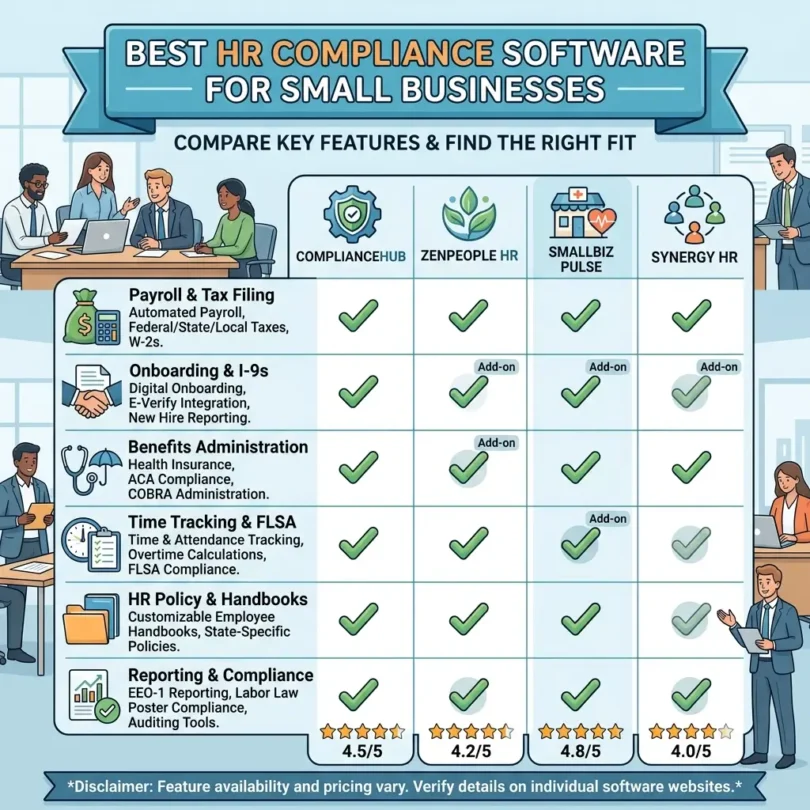
| HR Compliance Software | Best For | Main Strength | Best Business Type |
|---|---|---|---|
| Gusto | Small businesses | Payroll, HR, documents, compliance alerts | U.S.-based SMBs |
| ADP RUN | Trusted payroll + HR | Payroll, tax, HR, compliance resources | Small businesses needing support |
| Paychex Flex | HR guidance | HR compliance support and access to professionals | Small and growing businesses |
| Mineral | Compliance content | Handbooks, templates, alerts, training | SMBs needing HR compliance guidance |
| Bambee | Human HR support | HR manager-style guidance and policies | Small businesses without HR staff |
| ComplyRight | Compliance documents | Forms, posters, notices, HR documents | Small businesses needing forms |
| TriNet Zenefits | All-in-one HR | HR, benefits, payroll, compliance tools | SMBs |
| Rippling | Automated workflows | HR, payroll, IT, lifecycle automation | Growing remote companies |
| Deel | Global compliance | International hiring and contractor compliance | Global/remote teams |
| Justworks | PEO support | Payroll, benefits, HR compliance support | Startups and SMBs |
Important Features to Look for in HR Compliance Software
The right HR compliance software depends on your business size, employee type, location, payroll setup, and risk level.
1. Payroll Compliance Support
Payroll compliance is one of the biggest HR risk areas. Look for software that supports payroll tax filing, wage calculations, overtime, deductions, and reports.
2. Employee Document Management
The system should securely store employee documents, contracts, tax forms, policy acknowledgments, and HR records.
3. Compliance Alerts
Compliance alerts help small businesses stay aware of changing rules and deadlines.
4. Employee Handbook Tools
Handbook templates and policy tools help businesses create clear workplace expectations.
5. HR Templates
Templates can save time for offer letters, policy acknowledgments, disciplinary notices, job descriptions, termination documents, and performance records.
6. Time and Attendance
Time tracking helps support wage and overtime compliance for hourly employees.
7. New Hire Reporting
New hire reporting is important in many jurisdictions. Payroll and HR platforms can help manage this process.
8. Benefits Compliance
If your business offers benefits, compliance tools should support eligibility, deductions, notices, and reporting.
9. Training
Some platforms provide workplace training, harassment prevention training, safety training, or policy training.
10. HR Expert Support
Small businesses often need guidance from HR professionals. This can be valuable when dealing with employee relations, leave, discipline, or termination.
HR Compliance Software vs HR Software
HR compliance software and HR software overlap, but they are not exactly the same.
HR Software
HR software usually manages:
- Employee records
- Payroll
- Benefits
- Time off
- Onboarding
- Performance
- Documents
- HR workflows
HR Compliance Software
HR compliance software focuses more on:
- Labor law alerts
- HR policy templates
- Employee handbooks
- Payroll compliance
- Training
- Notices
- Compliance reporting
- Audit support
- HR documentation
- Expert guidance
Some platforms combine both. Gusto, ADP, Paychex, Zenefits, Rippling, Deel, and Justworks can include both HR management and compliance support.
Best HR Compliance Software by Business Type
Best for Small Businesses
Gusto, Paychex Flex, ADP RUN, Bambee, and Mineral are strong options.
Best for Businesses Without HR Staff
Bambee, Paychex, Justworks, ADP, and Gusto Premium/HR add-ons can be useful because they provide guidance and resources.
Best for Payroll Compliance
ADP, Paychex, Gusto, Rippling, and Justworks are strong options.
Best for Employee Handbooks and Templates
Mineral, Bambee, ComplyRight, Gusto, and Paychex can be helpful.
Best for Global Compliance
Deel and Rippling are better for companies hiring internationally.
Best for PEO Support
Justworks, TriNet, and ADP TotalSource-style PEO solutions are more relevant for companies wanting outsourced HR support.
How Much Does HR Compliance Software Cost?
HR compliance software pricing depends on:
- Number of employees
- Payroll features
- HR support level
- Compliance alerts
- Employee handbook tools
- Document storage
- Training modules
- Benefits administration
- Time tracking
- Expert HR support
- PEO services
- Global compliance features
- Monthly or annual billing
Basic compliance resources may cost less. Full-service payroll, HR support, PEO services, and global compliance can cost more.
When comparing pricing, ask:
- Is payroll included?
- Are tax filings included?
- Are compliance alerts included?
- Are HR templates included?
- Is handbook support included?
- Is expert HR support included?
- Is time tracking included?
- Are training modules included?
- Is benefits compliance included?
- Are global compliance tools included?
- Is support included?
The cheapest option may not be enough if your business has multiple employees, hourly workers, benefits, remote workers, or multi-state operations.
Common HR Compliance Mistakes Small Businesses Make
Mistake 1: Using Outdated Handbooks
An old handbook can create confusion and may not reflect current workplace policies.
Mistake 2: Poor Employee Documentation
Missing offer letters, policy acknowledgments, time records, or disciplinary documentation can create problems later.
Mistake 3: Misclassifying Workers
Employees and contractors should be classified carefully.
Mistake 4: Weak Time Tracking
Poor time records can create wage and overtime issues.
Mistake 5: Ignoring Leave Rules
Sick leave, family leave, vacation, unpaid leave, and local leave rules can vary.
Mistake 6: No New Hire Process
New hires need proper forms, policies, payroll setup, and onboarding records.
Mistake 7: No HR Support Before Termination
Terminations should be documented carefully and handled consistently.
Mistake 8: Storing HR Data in Random Folders
Employee data should be stored securely with access controls.
HR Compliance Best Practices
Create a Clear Employee Handbook
Your handbook should explain policies for attendance, conduct, leave, remote work, benefits, harassment, safety, discipline, and workplace expectations.
Keep Employee Records Organized
Store documents securely in an HR system.
Use Payroll Software
Payroll software reduces manual tax and wage calculation errors.
Track Time Accurately
Hourly employees need accurate time and attendance records.
Review Policies Regularly
Update policies when laws, benefits, or business practices change.
Train Managers
Managers should understand basic HR rules, documentation, feedback, and escalation procedures.
Use Templates Carefully
Templates save time, but they should fit your actual business and location.
Get Expert Help When Needed
Employee relations, leave, discipline, and termination issues may require HR or legal guidance.
Protect Employee Data
HR data includes sensitive personal and payroll information. Limit access and use secure systems.
Final Verdict: What Is the Best HR Compliance Software?
The best HR compliance software depends on your business size, location, payroll needs, and HR risk level.
For most small businesses:
- Best overall HR compliance software: Gusto
- Best trusted payroll and compliance provider: ADP RUN
- Best HR compliance support with professionals: Paychex Flex
- Best compliance content and templates: Mineral
- Best human HR guidance for small businesses: Bambee
- Best HR forms and labor law documents: ComplyRight
- Best all-in-one SMB HR and compliance: TriNet Zenefits
- Best for automated HR workflows: Rippling
- Best for global HR compliance: Deel
- Best PEO-style compliance support: Justworks
If your business mainly needs payroll and compliance basics, start with Gusto, ADP, or Paychex. If you need HR guidance and policies, compare Bambee and Mineral. If you need global compliance, compare Deel and Rippling. If you want outsourced HR support and benefits through a PEO model, compare Justworks.
The most important point is simple: HR compliance software helps small businesses reduce risk, organize employee records, follow payroll rules, manage policies, and get guidance before small HR problems become expensive mistakes.
FAQs About HR Compliance Software
What is the best HR compliance software for small businesses?
The best HR compliance software depends on your needs. Gusto is strong for payroll and HR compliance, ADP is a trusted payroll and compliance provider, Paychex offers HR compliance support and professional guidance, Mineral is strong for compliance templates, and Bambee is useful for small businesses needing human HR support.
What does HR compliance software do?
HR compliance software helps businesses manage payroll compliance, employee documents, labor law alerts, HR policies, handbooks, training, new hire records, time tracking, benefits compliance, and HR reporting.
Do small businesses need HR compliance software?
Yes. Small businesses need HR compliance software when they hire employees, run payroll, track hours, manage benefits, store employee documents, or need workplace policies.
Is Gusto good for HR compliance?
Yes. Gusto offers HR compliance services for small businesses, including Compliance Hub, proactive alerts, and in-app guidance, with additional expert support and templates on eligible plans or add-ons.
Is ADP good for small business compliance?
Yes. ADP offers payroll and HR solutions plus tax, compliance, and benefit administration services. It also provides small business compliance resources.
Is Paychex good for HR compliance?
Yes. Paychex small business solutions can include HR compliance support, tax filing, new hire reporting, time tracking, benefits administration, and access to HR professionals.
What is HR compliance?
HR compliance means following employment laws, payroll rules, workplace policies, employee documentation requirements, benefits rules, time tracking standards, and labor regulations that apply to your business.
Can HR compliance software replace a lawyer?
No. HR compliance software can help with tools, templates, alerts, and guidance, but it does not replace legal advice. For serious legal issues, consult a qualified attorney.
What HR documents should small businesses keep?
Small businesses should keep offer letters, employment agreements, tax forms, payroll records, time records, policy acknowledgments, performance documents, benefits records, leave records, and termination documents.
What is the difference between HR software and HR compliance software?
HR software manages employee records, payroll, benefits, onboarding, time off, and HR workflows. HR compliance software focuses more on labor law alerts, policies, handbooks, payroll compliance, forms, training, and audit-ready documentation.