
Performance management is one of the most important parts of building a strong company. Hiring good people is only the first step. After employees join, managers and HR teams need to help them grow, set clear goals, give useful feedback, review progress, recognize strong work, and identify performance problems early.
The old performance review system is no longer enough for modern teams. Many companies used to review employees once a year, write a few notes, give a rating, and move on. That approach often feels slow, stressful, and disconnected from daily work.
Modern businesses need a better system.
The best performance management software helps HR teams run performance reviews, set goals, manage OKRs, collect 360 feedback, support 1-on-1 meetings, track employee development, improve manager coaching, and use performance data to make better people decisions.
For HR teams, performance management software is not only about rating employees. It is about building a culture where people understand expectations, receive regular feedback, develop skills, and stay aligned with company goals.
In this guide, we will compare the best performance management software for HR teams, explain the most important features, and help you choose the right platform for your company.
What Is Performance Management Software?
Performance management software is a digital tool that helps companies manage employee performance, feedback, goals, reviews, development, and manager-employee conversations.
A performance management platform can help with:
- Performance reviews
- 360-degree feedback
- Manager feedback
- Peer feedback
- Employee self-reviews
- Goal tracking
- OKRs
- 1-on-1 meetings
- Check-ins
- Performance improvement plans
- Talent reviews
- Calibration
- Employee development
- Career paths
- Compensation review support
- Engagement insights
- Performance analytics
BambooHR explains performance management software as a way for organizations to run reviews, track goals, and collect employee feedback without spreadsheets or clunky tools.
A strong performance management system gives HR teams a clear process for reviewing employees and gives managers better tools to coach their teams.
Why HR Teams Need Performance Management Software
HR teams need performance management software because manual performance reviews are hard to manage.
Without software, companies often rely on spreadsheets, Word documents, email reminders, scattered manager notes, and inconsistent review forms. That creates confusion and weak data.
1. Reviews Become Easier to Manage
HR teams can create review cycles, assign participants, send reminders, collect feedback, and track completion in one platform.
2. Feedback Becomes More Consistent
Instead of managers writing random notes, performance software can use templates, scorecards, rating scales, and structured questions.
3. Goals Stay Visible
Employees and managers can track goals throughout the year instead of only discussing them during annual reviews.
4. Managers Get Better Coaching Tools
Managers can use 1-on-1 agendas, check-ins, feedback history, and performance summaries to support employees more effectively.
5. HR Gets Better Performance Data
Performance management software helps HR see trends across teams, departments, managers, and roles.
6. Talent Decisions Become More Fair
Structured reviews and calibration can help reduce inconsistent ratings and improve promotion, compensation, and development decisions.
7. Employees Understand Expectations
Employees perform better when they know what success looks like, how they are being evaluated, and what they need to improve.
Best Performance Management Software for HR Teams
Below are some of the strongest performance management platforms for HR teams, people operations teams, managers, startups, small businesses, mid-sized companies, and enterprise organizations.
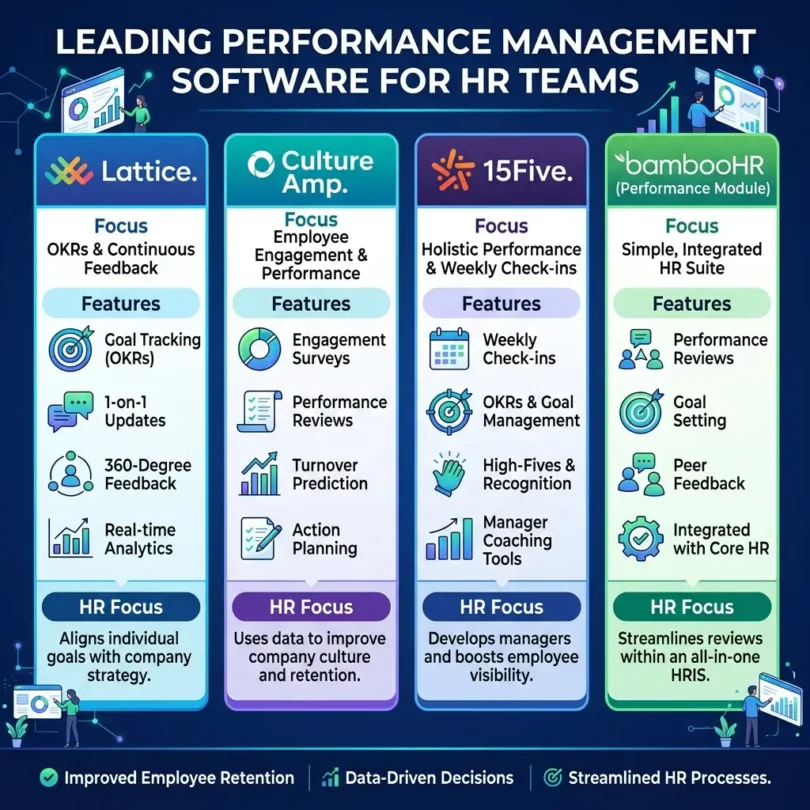
1. Lattice
Best for: Growing companies that want performance, goals, engagement, and people analytics
Good for: Performance reviews, 1-on-1s, feedback, OKRs, engagement, talent reviews
Main strength: Complete people management platform focused on performance and culture
Lattice is one of the most popular performance management software platforms for HR teams. It helps companies manage performance reviews, goals, feedback, 1-on-1 meetings, engagement, compensation, and people analytics.
Lattice says its performance tools include performance reviews, succession planning, performance improvement plans, real-time feedback, and 1-on-1 meeting management.
Key Features
- Performance reviews
- 360-degree feedback
- Real-time feedback
- 1-on-1 meetings
- Goal tracking
- OKRs
- Performance improvement plans
- Talent reviews
- Calibration
- Succession planning
- Engagement surveys
- People analytics
- Compensation tools
- Integrations with HR tools
Why Lattice Is Good for HR Teams
Lattice is strong because it brings performance management and employee engagement into one connected system. HR teams can run review cycles, track goals, collect feedback, and help managers hold better 1-on-1 conversations.
It is especially useful for companies that want continuous performance management instead of only annual reviews.
Lattice also positions itself as an HR and AI platform used by 5,000+ teams to manage people and performance.
Best Fit
Lattice is best for growing companies that want a polished performance management platform with reviews, goals, 1-on-1s, engagement, and people analytics.
Possible Downsides
Lattice can be more than a very small business needs. Companies with only basic review needs may prefer BambooHR, PerformYard, or Zoho People.
2. 15Five
Best for: Continuous feedback and manager enablement
Good for: Weekly check-ins, performance reviews, 360 feedback, engagement, goals, coaching
Main strength: Helping managers build better performance conversations
15Five is a performance management platform focused on continuous feedback, manager effectiveness, engagement, goals, and performance reviews.
15Five says its platform includes modules for performance reviews, engagement surveys, manager enablement, feedback, goals and alignment, compensation signals, and AI-powered insights.
Key Features
- Performance reviews
- Weekly check-ins
- 360 feedback
- Manager enablement
- Goals and OKRs
- Engagement surveys
- Feedback tools
- Talent reviews
- AI-powered insights
- Performance reporting
- HRIS integrations
- Compensation and promotion signals
Why 15Five Is Good for HR Teams
15Five is strong because it helps managers stay connected to employees between formal review cycles. Weekly check-ins and manager tools help identify problems early, celebrate wins, and keep goals visible.
15Five Perform supports performance reviews, 360 feedback, talent reviews, AI-assisted reviews, standardized ratings, talent matrix calibration, performance reporting, goal and OKR tracking, and HRIS integrations.
Best Fit
15Five is best for HR teams that want continuous feedback, weekly check-ins, manager coaching, engagement insights, and performance reviews.
Possible Downsides
Companies that want a more traditional review-only platform may find 15Five broader than necessary.
3. Culture Amp
Best for: Employee experience, performance, engagement, and development
Good for: Performance reviews, calibration, engagement surveys, 1-on-1s, growth plans
Main strength: Combining performance management with employee engagement and people science
Culture Amp is an employee experience platform that includes performance management, employee engagement, development, surveys, analytics, and people science recommendations.
Culture Amp’s performance platform includes continuous feedback, performance reviews and calibration, 1-on-1 conversations, career paths and competencies, personalized growth plans, retention insights, DEI surveys, and AI comment summaries.
Key Features
- Performance reviews
- Review calibration
- Continuous feedback
- 1-on-1 conversations
- Employee engagement surveys
- DEI surveys
- Retention insights
- Career paths
- Competencies
- Skills coaching
- Personalized growth plans
- AI comment summaries
- Develop analytics
- People science recommendations
Why Culture Amp Is Good for HR Teams
Culture Amp is strong because it connects performance with engagement and development. HR teams can understand not only how employees perform, but also how they feel, what support they need, and where development opportunities exist.
This is useful for companies that want to build a performance culture without ignoring employee experience.
Culture Amp describes itself as an employee experience platform that supports engagement, performance, and development tools in one platform.
Best Fit
Culture Amp is best for companies that want performance reviews, engagement surveys, employee development, and people insights in one platform.
Possible Downsides
Culture Amp may be more expensive or advanced than what small companies need for basic reviews.
4. BambooHR Performance Management
Best for: Small and mid-sized businesses using BambooHR
Good for: Simple reviews, goals, employee feedback, HRIS-connected performance
Main strength: Performance management inside an easy HR platform
BambooHR Performance Management is a good option for small and mid-sized businesses that already use BambooHR or want performance tools connected with HR records.
BambooHR says its performance management tools help HR teams run reviews, track goals, and collect employee feedback without spreadsheets or clunky tools.
Key Features
- Performance reviews
- Employee feedback
- Goal tracking
- Simple review cycles
- HRIS integration
- Employee records
- Manager feedback
- Performance data
- Employee self-service
- Reporting
- HR workflows
Why BambooHR Performance Management Is Good
BambooHR is useful because many small businesses need simple performance management, not a large enterprise platform. If your company already uses BambooHR for HR records, adding performance management can keep employee data and reviews in one place.
BambooHR is also known as a cloud-based HR platform for small and medium-sized businesses with hiring, onboarding, payroll, benefits, performance management, time tracking, employee self-service, reporting, and 150+ integrations.
Best Fit
BambooHR Performance Management is best for small and mid-sized businesses that want simple performance reviews and goal tracking connected with HR data.
Possible Downsides
Companies needing advanced engagement analytics, calibration, succession planning, or compensation planning may prefer Lattice, 15Five, Culture Amp, Leapsome, or Workday.
5. Leapsome
Best for: Performance, engagement, learning, and OKRs in one platform
Good for: Reviews, goals, employee development, feedback, surveys, learning paths
Main strength: Integrated performance and development platform
Leapsome is a people enablement platform that combines performance reviews, goals, OKRs, engagement surveys, feedback, learning, and employee development.
Key Features
- Performance reviews
- 360 feedback
- Goals and OKRs
- Continuous feedback
- Employee engagement surveys
- Learning modules
- Career development
- Competency frameworks
- 1-on-1 meetings
- Employee development plans
- Analytics and reporting
- HRIS integrations
Why Leapsome Is Good for HR Teams
Leapsome is useful because performance management is connected with learning and development. Instead of simply rating employees, HR teams can connect feedback with development plans, learning paths, and growth conversations.
This makes it a strong fit for companies that want employees to improve continuously.
Best Fit
Leapsome is best for HR teams that want performance management, engagement, goals, and learning in one platform.
Possible Downsides
Leapsome may be more than a company needs if it only wants simple annual performance reviews.
6. PerformYard
Best for: Flexible performance reviews
Good for: Custom review cycles, 360 feedback, goals, continuous feedback
Main strength: Flexible review workflows without unnecessary complexity
PerformYard is a performance management platform focused on flexible review cycles, feedback, goal tracking, and performance reporting.
A 2026 comparison article described PerformYard as focused on flexible review cycles, continuous feedback, and goal tracking, with optional engagement survey and meeting add-ons.
Key Features
- Performance reviews
- 360 feedback
- Custom review cycles
- Continuous feedback
- Goal tracking
- Review templates
- Manager feedback
- Employee self-reviews
- Performance reporting
- Engagement survey add-ons
- Meeting add-ons
- HRIS integrations
Why PerformYard Is Good for HR Teams
PerformYard is strong for HR teams that want control over their performance review process. Some companies need annual reviews, others need quarterly reviews, project-based reviews, peer reviews, upward feedback, or custom manager assessments.
PerformYard can support different review styles without forcing one rigid process.
Best Fit
PerformYard is best for companies that want flexible performance review workflows and goal tracking.
Possible Downsides
Companies wanting a broader employee experience platform with engagement, learning, and compensation may prefer Lattice, Culture Amp, 15Five, or Leapsome.
7. Workday Performance Management
Best for: Large companies and enterprise HR teams
Good for: Enterprise HCM, goals, performance reviews, talent management, analytics
Main strength: Performance management inside enterprise HR ecosystem
Workday is a major enterprise HCM platform. Its performance management capabilities are part of a broader HR, talent, workforce planning, payroll, and analytics ecosystem.
Key Features
- Performance reviews
- Goal management
- Talent management
- Career development
- Succession planning
- Workforce analytics
- Skills and competencies
- Employee profiles
- Manager dashboards
- Compensation planning support
- Enterprise reporting
- HCM integration
Why Workday Is Good for HR Teams
Workday is powerful for large companies that need performance management connected with HR, payroll, finance, workforce planning, talent management, and enterprise analytics.
It is best for organizations that need scale, governance, reporting, and HR process consistency across many departments or countries.
Best Fit
Workday Performance Management is best for large companies and enterprises using Workday HCM.
Possible Downsides
Workday is too complex and expensive for most small businesses.
8. SAP SuccessFactors Performance & Goals
Best for: Enterprise performance and goal management
Good for: Large companies, global teams, structured performance, talent management
Main strength: Enterprise performance management connected with SAP HCM ecosystem
SAP SuccessFactors is an enterprise HCM platform with performance and goal management capabilities. It is designed for large organizations that need global HR processes, performance reviews, talent management, succession, learning, and workforce analytics.
Key Features
- Performance reviews
- Goal management
- Continuous performance management
- 360 feedback
- Calibration
- Talent management
- Succession planning
- Learning integration
- Workforce analytics
- HR data integration
- Global HR support
- Enterprise compliance features
Why SAP SuccessFactors Is Good for HR Teams
SAP SuccessFactors is useful for large organizations that need performance management connected with broader enterprise HR and talent processes.
It works well when companies need structured performance management at scale across multiple teams, business units, or countries.
Best Fit
SAP SuccessFactors is best for large enterprises and global organizations using SAP HR systems.
Possible Downsides
It is not ideal for small businesses or teams that need a simple, lightweight performance review tool.
9. Zoho People
Best for: Affordable HR and performance management
Good for: Small businesses, Zoho users, goal tracking, appraisals, HR workflows
Main strength: Cost-effective HR system with performance features
Zoho People is an HR software platform that includes employee management, attendance, leave, workflows, and performance management features. It is especially useful for businesses already using Zoho products.
Key Features
- Employee database
- Performance appraisals
- Goals and KRAs
- Feedback
- Competency tracking
- HR workflows
- Attendance and leave management
- Employee self-service
- Reports
- Zoho ecosystem integrations
- Custom forms
- Mobile access
Why Zoho People Is Good for HR Teams
Zoho People is useful for small businesses that need HR and performance tools at a lower cost. It may not have the same depth as Lattice or Culture Amp, but it can be a practical option for companies already using Zoho CRM, Zoho Mail, Zoho Books, or Zoho Projects.
Best Fit
Zoho People is best for small businesses and Zoho users that want affordable HR and performance management features.
Possible Downsides
The user experience may feel less polished than premium performance platforms.
10. Betterworks
Best for: OKRs, goals, performance enablement, and enterprise alignment
Good for: Goal alignment, continuous performance, feedback, employee development
Main strength: Connecting goals with performance and business outcomes
Betterworks is a performance enablement platform focused on goals, OKRs, continuous performance, feedback, and alignment. It helps companies connect employee work to company priorities.
Key Features
- Goals and OKRs
- Performance reviews
- Continuous feedback
- Check-ins
- Employee conversations
- Goal alignment
- Manager tools
- Analytics
- Calibration support
- Engagement insights
- Enterprise integrations
Why Betterworks Is Good for HR Teams
Betterworks is useful for companies that want performance management to be strongly connected with business goals. It helps employees understand how their work supports company priorities.
This is valuable for organizations that use OKRs or want stronger goal alignment across teams.
Best Fit
Betterworks is best for companies that want goal alignment, OKRs, continuous feedback, and performance enablement.
Possible Downsides
Companies that only need simple review forms may prefer BambooHR, PerformYard, or Zoho People.
Quick Comparison Table
| Performance Software | Best For | Main Strength | Best Business Type |
|---|---|---|---|
| Lattice | Growing companies | Reviews, goals, 1-on-1s, analytics | Startups and mid-market teams |
| 15Five | Manager enablement | Check-ins, feedback, reviews, engagement | Coaching-focused teams |
| Culture Amp | Employee experience | Performance, engagement, development | People-first organizations |
| BambooHR Performance | SMBs | Simple reviews and goals inside HRIS | Small and mid-sized businesses |
| Leapsome | People enablement | Performance, engagement, learning, OKRs | Growing HR teams |
| PerformYard | Flexible reviews | Custom review cycles and feedback | Companies needing review flexibility |
| Workday | Enterprise HCM | Talent, goals, analytics at scale | Large companies |
| SAP SuccessFactors | Enterprise HR | Global performance and goals | Large/global organizations |
| Zoho People | Affordable HR | Appraisals, goals, Zoho integrations | Small businesses |
| Betterworks | Goal alignment | OKRs and performance enablement | Goal-driven companies |
Important Features to Look for in Performance Management Software
The best performance management software depends on your company culture, review process, manager maturity, and HR goals.
1. Performance Reviews
The platform should support annual, semiannual, quarterly, or custom review cycles.
2. 360-Degree Feedback
360 feedback collects input from managers, peers, direct reports, and sometimes cross-functional teammates.
3. Self-Reviews
Self-reviews help employees reflect on achievements, challenges, and growth areas.
4. Goal Tracking
Goals should be visible throughout the review period, not forgotten until the review deadline.
5. OKRs
OKRs help align employee and team goals with company priorities.
6. 1-on-1 Meetings
1-on-1 tools help managers discuss progress, blockers, feedback, and employee development regularly.
7. Continuous Feedback
Continuous feedback helps employees improve during the year instead of waiting for annual reviews.
8. Calibration
Calibration helps companies compare ratings fairly across teams and reduce inconsistent scoring.
9. Talent Reviews
Talent reviews help HR and leadership identify high performers, growth potential, succession needs, and development gaps.
10. Analytics
Performance analytics show completion rates, rating distribution, goal progress, manager quality, and team trends.
11. Employee Development
A strong platform should connect feedback with development plans, learning resources, competencies, or career paths.
12. HRIS Integration
Performance software should integrate with employee data from HR systems to keep records accurate.
Performance Management Software vs HR Software
Performance management software and HR software are connected, but they are not exactly the same.
HR Software
HR software usually manages:
- Employee records
- Payroll
- Benefits
- Time off
- Documents
- Onboarding
- Compliance
- HR workflows
Performance Management Software
Performance software manages:
- Reviews
- Feedback
- Goals
- OKRs
- 1-on-1s
- Development
- Calibration
- Talent reviews
- Performance analytics
Some HR platforms include performance features. BambooHR, Zoho People, Workday, SAP SuccessFactors, and Paycor can include both HR and performance management.
Specialized platforms like Lattice, 15Five, Culture Amp, Leapsome, PerformYard, and Betterworks focus more deeply on performance and people development.
Best Performance Management Software by Business Type
Best for Small Businesses
BambooHR, Zoho People, PerformYard, and 15Five are practical options for small businesses.
Best for Growing Companies
Lattice, 15Five, Culture Amp, Leapsome, and Betterworks are strong choices for growing companies.
Best for Manager Coaching
15Five is especially strong for weekly check-ins, feedback, and manager enablement.
Best for Employee Engagement and Performance
Culture Amp, Lattice, 15Five, and Leapsome are strong because they connect performance with engagement.
Best for OKRs and Goal Alignment
Betterworks, Lattice, Leapsome, and 15Five are good options.
Best for Flexible Review Cycles
PerformYard is a strong option if your company needs custom review workflows.
Best for Enterprise HR
Workday and SAP SuccessFactors are better for large, global, and enterprise organizations.
How Much Does Performance Management Software Cost?
Performance management software pricing depends on:
- Number of employees
- Number of admins
- Review features
- Goal tracking
- OKRs
- Engagement surveys
- 1-on-1 tools
- Learning and development modules
- Compensation tools
- Analytics
- HRIS integrations
- Implementation support
- Annual vs monthly billing
Some vendors publish pricing. Others require custom quotes. BambooHR, for example, often requires contacting sales for pricing, and TechRadar notes this can make direct comparisons harder.
When comparing pricing, ask:
- Is pricing per employee?
- Are performance reviews included?
- Are 360 reviews included?
- Are goals and OKRs included?
- Are engagement surveys extra?
- Are 1-on-1 tools included?
- Are calibration tools included?
- Are analytics included?
- Is HRIS integration included?
- Is implementation support included?
- Is customer support included?
Do not choose only the cheapest platform. Poor performance management can create unclear expectations, weak feedback, employee frustration, and bad promotion decisions.
Common Performance Management Mistakes
Mistake 1: Only Doing Annual Reviews
Annual reviews are often too late to fix performance problems. Continuous feedback is better.
Mistake 2: No Clear Goals
Employees cannot perform well if they do not know what success looks like.
Mistake 3: Manager Feedback Is Too Vague
Feedback should be specific, timely, and connected to real examples.
Mistake 4: No Calibration
Without calibration, one manager may rate strictly while another rates generously.
Mistake 5: Reviews Are Disconnected From Development
A review should lead to a growth plan, not just a rating.
Mistake 6: HR Runs Reviews but Managers Do Not Engage
Managers are central to performance management. Software cannot replace manager responsibility.
Mistake 7: Too Many Complicated Forms
Long review forms reduce completion quality. Keep forms focused and useful.
Mistake 8: No Follow-Up
A performance review without follow-up is a missed opportunity.
Performance Management Best Practices
Set Clear Goals Early
Employees should know expectations before the review period begins.
Use Regular Check-Ins
Monthly or weekly check-ins help managers support employees before problems grow.
Collect Balanced Feedback
Use manager feedback, peer input, self-reviews, and goal data where appropriate.
Train Managers
Managers need training on giving feedback, coaching employees, and using review tools fairly.
Keep Reviews Simple
Use focused questions that produce useful feedback.
Connect Feedback to Growth
Every review should include development actions, goals, or learning opportunities.
Use Calibration Carefully
Calibration helps ensure fairness across teams.
Review Performance Data
HR should look for patterns in ratings, promotions, goal completion, and manager behavior.
Focus on Improvement
Performance management should help employees improve, not only judge them.
Final Verdict: What Is the Best Performance Management Software?
The best performance management software depends on your company size, review process, culture, and HR goals.
For most HR teams:
- Best overall performance platform: Lattice
- Best for manager enablement: 15Five
- Best for employee experience: Culture Amp
- Best for SMBs using HR software: BambooHR Performance Management
- Best for performance plus development: Leapsome
- Best for flexible review cycles: PerformYard
- Best for enterprise HCM: Workday
- Best for global enterprise HR: SAP SuccessFactors
- Best affordable HR performance option: Zoho People
- Best for OKRs and goal alignment: Betterworks
If your company wants a polished performance and people management platform, start with Lattice. If manager coaching and check-ins matter most, compare 15Five. If employee engagement and development are also priorities, compare Culture Amp and Leapsome. If you need a simple SMB solution, compare BambooHR, PerformYard, and Zoho People.
The most important point is simple: performance management software should make feedback clearer, goals more visible, managers more effective, and employees more successful.
FAQs About Performance Management Software
What is the best performance management software?
The best performance management software depends on company needs. Lattice is strong overall, 15Five is great for manager enablement, Culture Amp is strong for engagement and development, BambooHR is practical for SMBs, and PerformYard is strong for flexible review cycles.
What does performance management software do?
Performance management software helps companies run reviews, track goals, collect feedback, manage 1-on-1s, support development, analyze performance data, and improve manager-employee conversations.
Is Lattice good for performance management?
Yes. Lattice includes performance reviews, succession planning, performance improvement plans, real-time feedback, and 1-on-1 meeting management.
Is 15Five good for HR teams?
Yes. 15Five includes performance reviews, engagement surveys, manager enablement, feedback, goals, compensation signals, and AI-powered insights.
Is Culture Amp good for performance reviews?
Yes. Culture Amp includes continuous feedback, performance reviews, calibration, 1-on-1 conversations, career paths, competencies, growth plans, and engagement insights.
What is 360-degree feedback?
360-degree feedback collects input from multiple people around an employee, such as managers, peers, direct reports, and cross-functional teammates.
What is the difference between performance management and employee engagement?
Performance management focuses on goals, feedback, reviews, and development. Employee engagement focuses on motivation, connection, satisfaction, and employee experience.
Do small businesses need performance management software?
Yes, small businesses can benefit from performance software when they need structured reviews, goal tracking, feedback, and better manager-employee conversations.
What is the best performance management software for SMBs?
BambooHR, 15Five, PerformYard, Zoho People, and Lattice can work well for SMBs depending on budget and needs.
How do I choose performance management software?
Choose based on review process, goals, 360 feedback, 1-on-1 tools, engagement features, analytics, HRIS integration, pricing, employee experience, and manager adoption.